CURATED ORIGINALS
50 Years of the Audemars Piguet Royal Oak: A Flying Tourbillon in Titanium
Fifty years after Gérald Genta sketched it overnight, the Royal Oak gets a distinctly modern reinterpretation: a flying tourbillon housed in featherlight titanium. Stripped of the iconic Tapisserie dial in favour of a sandblasted blue face, this 2022 anniversary edition lets the exposed, dancing tourbillon take centre stage. It's proof that even an icon born in 1972 still has room to evolve – without ever losing what made it one in the first place.
4 Minutes

A Design That Changed Watchmaking
The story of the Royal Oak began in 1970, when three Audemars Piguet distributors challenged the manufacture to create a stainless-steel watch that was both sporty and elegant. Managing Director Georges Golay turned to watch designer Gérald Genta, who produced his first sketch overnight. Inspired by a diver's helmet, Genta designed a water-resistant monocoque case topped by an octagonal bezel with eight visible hexagonal screws. He paired this unconventional case with an integrated bracelet, a blue dial decorated with the distinctive guilloché pattern that would become known as Tapisserie, and intricate finishing that treated steel with the same care traditionally reserved for precious metals. Bringing the design to life proved difficult and required two years of development, with specialist manufacturers enlisted to produce the case, dial, and bracelet.
When the Royal Oak finally debuted at the Basel Fair in April 1972, its combination of stainless steel, high horology finishing, unconventional construction, and unprecedented price challenged traditional ideas of what a luxury watch could be. What began as a stainless-steel time-and-date watch would evolve considerably over the following decades, as Audemars Piguet expanded the Royal Oak into new sizes, materials, colours, and increasingly complicated models such as the Royal Oak Perpetual Calendar. The original design remained at its core, even as the collection grew far beyond Genta's initial concept.

In 2022, Audemars Piguet celebrated the 50th anniversary of the Royal Oak by adding a broad range of new models to its most famous collection. Included were three new versions of the Royal Oak Selfwinding Flying Tourbillon, which had made its debut just two years earlier.
While all three references built on the design introduced in 2020, they also incorporated changes developed for the Royal Oak's 50th anniversary. The titanium Royal Oak Selfwinding Flying Tourbillon ref. 26730TI.OO.1320TI.01 brought a distinctly modern touch to this new generation, pairing the technical complexity of the flying tourbillon with lightweight construction and a restrained dial design that departs from the famed Tapisserie pattern.

A Lighter Take on the Royal Oak
Crafted entirely from titanium, ref. 26730TI.OO.1320TI.01 combines a 41 mm case with the Royal Oak's signature integrated bracelet in the same lightweight metal. The material gives a watch of this size and complexity a noticeably lighter presence on the wrist, while retaining the alternating satin-finished and polished surfaces that have long been central to the Royal Oak's design. Despite housing a flying tourbillon, the case measures a relatively slender 10.6 mm thick and is water-resistant to 50 metres.
Although the 2022 models retain the dimensions of the original Selfwinding Flying Tourbillons, they benefit from the design refinements Audemars Piguet introduced across the Royal Oak line for its 50th anniversary. Wider bevels on the case and bracelet accentuate the transition between brushed and polished surfaces, while the first links of the bracelet gradually decrease in thickness to improve both its proportions and comfort on the wrist. Audemars Piguet also slightly recessed the sapphire caseback into the case middle, allowing the watch to sit more comfortably against the wrist.
The Royal Oak's Tapisserie Dial
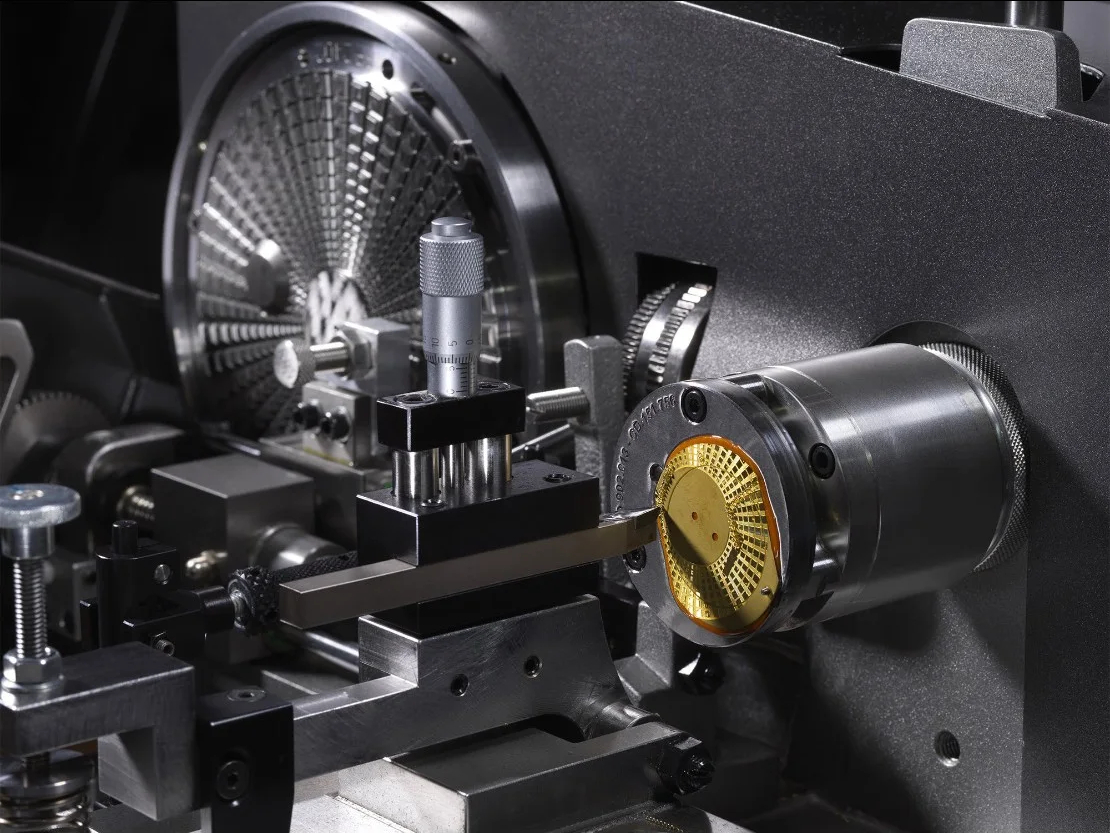
The Tapisserie dial has been closely associated with the Royal Oak since the first model debuted in 1972. Developed by Geneva dial-maker Stern Frères in collaboration with Gérald Genta, the original pattern, now known as Petite Tapisserie, consists of hundreds of small, truncated pyramids set against a textured base made up of tens of thousands of tiny diamond shapes. Over the following decades, it became one of the Royal Oak's defining design codes, appearing across models of different sizes, colours, and complications.
Creating Tapisserie traditionally involves specialised guilloché copying machines called pantographers that reproduce an enlarged master pattern at a much smaller scale. As a tracing tool known as a feeler follows the contours of the master, a connected engraving tool called a burin cuts the corresponding pattern into the dial. Petite Tapisserie was joined by Grande Tapisserie in 1999, which uses significantly larger pyramids, followed in 2001 by the still larger Méga Tapisserie developed for the Royal Oak Offshore. Unlike Petite and Grande Tapisserie, however, Méga Tapisserie is produced by stamping rather than traditional guilloché work.
Breaking with Tapisserie
While the Grande Tapisserie dial, characterised by a hobnail pattern, remains one of the Royal Oak's most recognisable design signatures, Audemars Piguet took a different approach with the titanium Selfwinding Flying Tourbillon from the very beginning.
When the complication joined the collection in 2020, the titanium reference was distinguished from its steel and pink gold counterparts by a sandblasted slate-grey dial rather than a Tapisserie pattern. Two years later, ref. 26730TI.OO.1320TI.01 continued that design direction with a sandblasted blue dial.
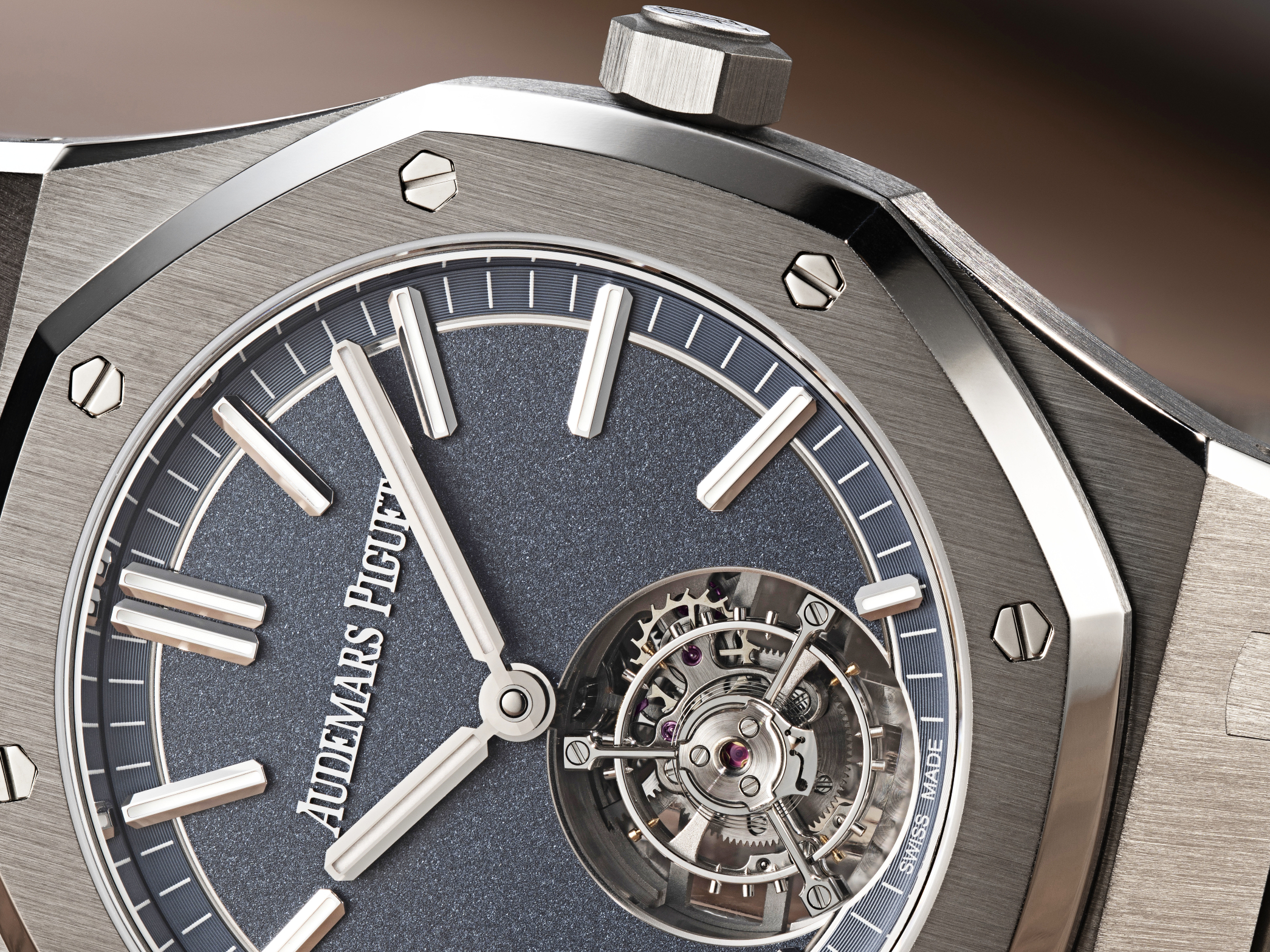
The blue dial is complemented by white gold applied hour markers and Royal Oak hands, both filled with luminescent material, along with the applied Audemars Piguet signature at 12 o'clock. Originally developed for Code 11.59, the three-dimensional signature is created through galvanic growth, a chemical process similar to 3D printing that builds up thin layers of 24k gold. The individual letters are connected by nearly invisible links, and the completed signature is applied to the dial by hand using tiny legs.
Set against the relatively minimal sandblasted dial, the exposed flying tourbillon at 6 o'clock becomes the natural focal point, its metallic tones echoed by the white gold hands and hour markers.
The Tourbillon at the Heart of the Royal Oak
Unlike a traditional tourbillon, whose rotating cage is supported by bridges above and below, a flying tourbillon is supported only from beneath. Removing the upper bridge leaves the mechanism unobstructed from the dial side, allowing the balance, escapement, and rotating cage to remain fully visible in motion.

Audemars Piguet first featured a flying tourbillon in a wristwatch in 2018 with the Royal Oak Concept, before bringing the complication to the Royal Oak two years later.
The Royal Oak Selfwinding Flying Tourbillon ref. 26730TI.OO.1320TI.01 is powered by the automatic Calibre 2950, which first appeared in Code 11.59. Comprising 270 components and 27 jewels, the movement operates at 21,600 vibrations per hour (3 Hz) and provides a minimum power reserve of 65 hours.
The sapphire caseback reveals a range of traditional movement finishes, including satin-finishing, snailing, hand-polished chamfers, and Côtes de Genève. For 2022, the Côtes de Genève are arranged in straight lines rather than the radiating pattern used on the 2020 models. Furthermore, as an anniversary model, the movement is fitted with a rhodium-toned 22k pink gold oscillating weight bearing the special “50-years” logo and an engraved Audemars Piguet signature.
Familiar Form, Modern Mechanics, Contemporary Character
Half a century after the original Royal Oak debuted in 1972, this 50th anniversary Royal Oak illustrates how Audemars Piguet has continued to reinterpret the model without losing sight of the design that made it famous.

The familiar octagonal case and integrated bracelet remain, but titanium construction, a sandblasted dial, and the flying tourbillon give the watch a distinctly contemporary character. At the same time, the ergonomic updates improve how the watch wears without substantially altering its recognisable silhouette.
The result brings together two sides of modern Audemars Piguet: the enduring design of the Royal Oak and the increasingly sophisticated mechanics the manufacture has introduced to the collection over the decades.