Rolex Milgauss at Seventy
Seventy Years of the Scientist's Watch
There are often watches that never quite get the credit they deserve, not because they lack substance, but because attention is diverted to other models from the brand. Perhaps Rolex's most important decade was the 1950s, as the Coronet experienced a golden run of collections from the Submariner, the GMT-Master, the Explorer, and the Day-Date. These now cornerstones of the brand’s catalogue first found their way onto wrists through diving, aviation, exploration, and business environments, each with a clear and defined story. Another release during the same decade, the Milgauss has a unique story too, but being built for scientists rather than adventurers, the hyper-specific nature of its use case meant its connection typically remained within the profession. Seventy years on, that mismatch between what the Milgauss was built to do and how little credit it has received for doing it is precisely what makes it worth honouring.
4 Minutes

The Milgauss arrived in 1956 with a mandate unrelated to depth ratings or time zones. One of the biggest enemies of a mechanical watch is a magnet, due to the fine steel hairspring at the heart of the movement. These coils are so delicate that a strong enough magnetic field can cause them to cling together, shortening their effective length and throwing off the movement’s rate entirely, sometimes causing a watch to gain minutes a day or stop dead altogether. For engineers and physicists working around strong electromagnetic fields, most notably at CERN, the European Organisation for Nuclear Research, this magnetic threat to their watches was very real. They needed a mechanical watch that would keep accurate time despite being surrounded by the kind of magnetism that stops a standard movement in its tracks. Rolex's solution was a Faraday cage built into the case itself, a shield of ferromagnetic alloy wrapped around the movement, capable of resisting fields up to 1,000 gauss, roughly ten to twenty times what an ordinary mechanical watch could withstand before its accuracy started to suffer. It also never carried a date window, a deliberate omission rather than a stylistic one since any aperture in the dial would have broken the continuity of the shield protecting the movement beneath it. Its name, mille, the French for a thousand, fused with gauss, the unit, is unusual for Rolex not because function-derived names are rare, but because Milgauss is unusually literal, a name that states a specific performance figure outright rather than gesturing at a broader capability or place.
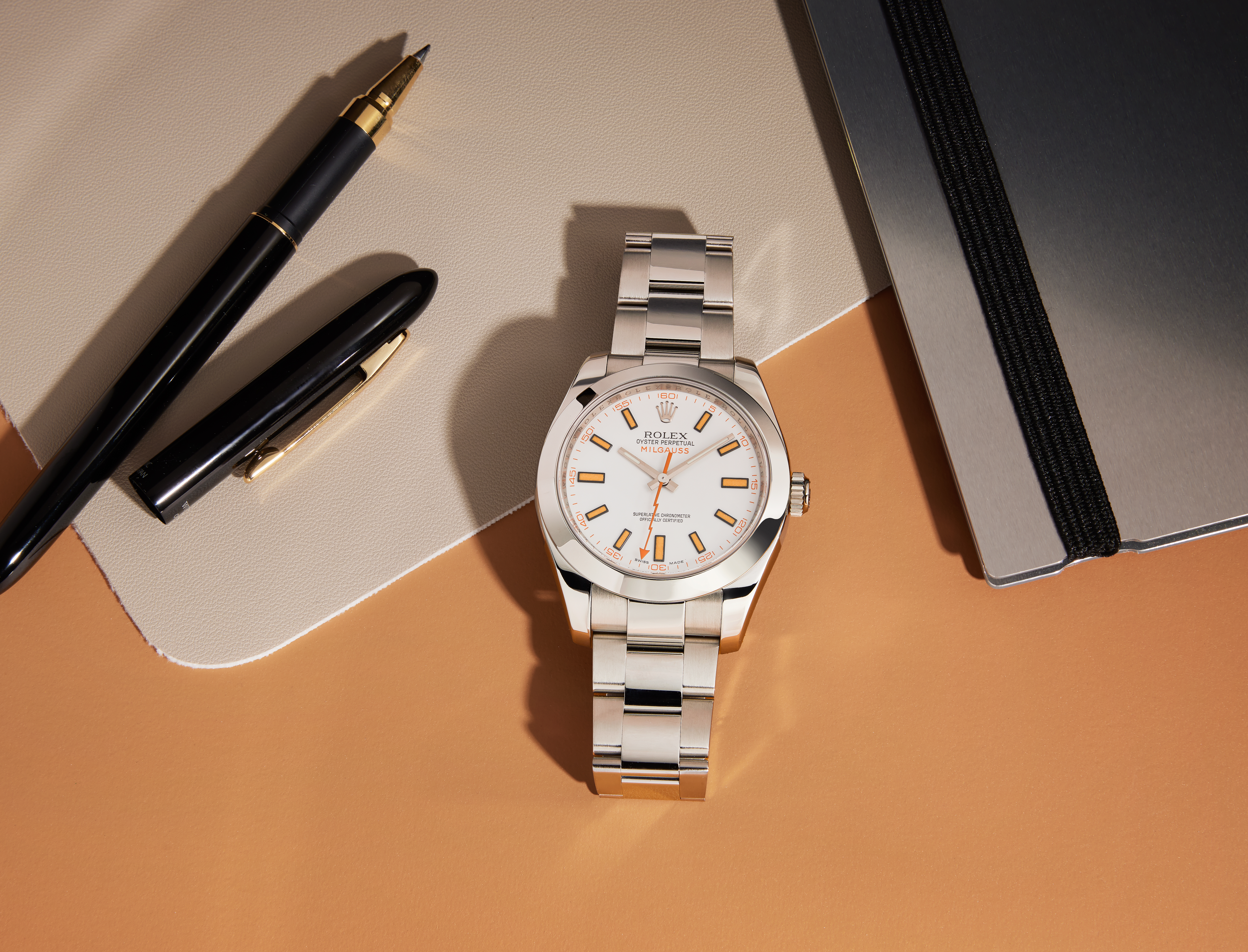
Chapter one of its story is written by the reference 6541, a watch that delivered a honeycomb dial, a rotating black bezel, dagger-shaped markers, the model's signature picked out in red, and the thunderbolt seconds hand that would become its calling card. The sense of alternative flair the Milgauss carries within the wider Rolex family traces back to that first reference. Its successor, the 1019 of 1960, took most of that character and developed it, exchanging the rotating bezel for a smooth one, the daggers for stick indices, and the thunderbolt for a red arrow-tipped hand. The 6541 lasted roughly four years, whereas the 1019 remained in the collection until 1988, a run of 28 years. What followed was a hiatus of almost two decades, ended in 2007 by the reference 116400, which arrived in three versions: black and white dials with an orange thunderbolt hand and matching orange accents, and the 116400GV beneath its green-tinted sapphire crystal, a manufacturing process so difficult to replicate that Rolex didn’t even patent it to ensure the process was kept a secret. The Z-Blue dial joined the GV in 2014, and by 2016 the range had narrowed to the green crystal models alone. And yet the story doesn't end there either. In 2023, Rolex pulled the Milgauss from its catalogue for a second time, leaving it without a current production model and prompting collectors to wonder whether this effective yet charmingly obscure watch will return.
Seventy years on from the arrival of the 6541, the anniversary hasn’t yet been officially marked by Rolex. Instead, a resistance to magnetism has been added to the criteria behind Superlative Chronometer certification, applied at the design and manufacturing stage across the catalogue rather than reserved for one watch. What that says about the Milgauss is perhaps more flattering, as the concern that once justified an entire reference, complete with a Faraday cage, has proven significant enough to warrant its inclusion in wider production. Seventy years after a small run of 6541s went out to scientists working near particle accelerators and power plants, the model continues to attract curiosity, telling a rare moment of unpredictability within the ever-awe-inspiring story of Rolex.