A Rare Moment of Extravagance in a Rolex Daytona Watch
Curated Originals: The Rolex Daytona “Leopard” 116598SACO
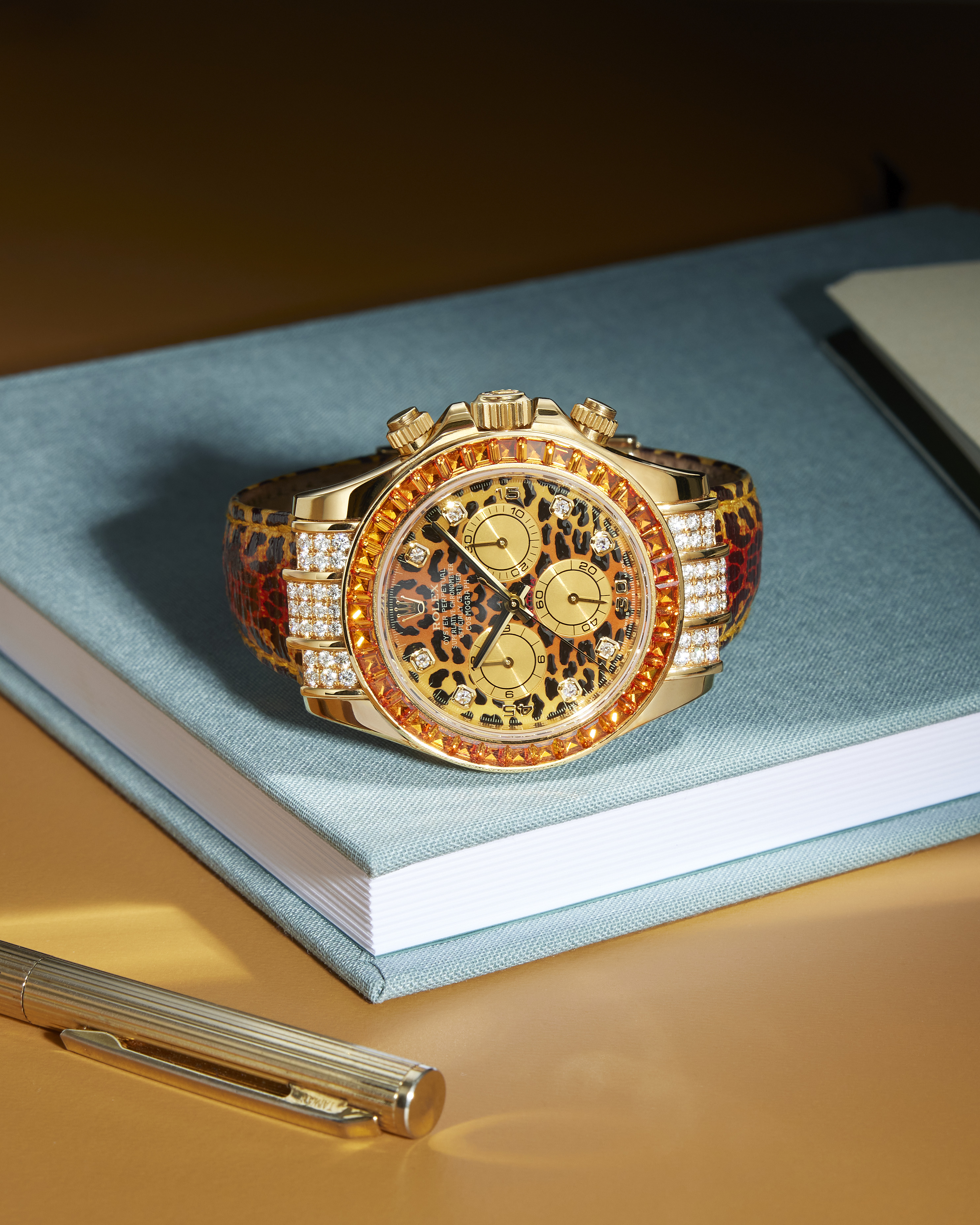
In an industry defined by evolution and heritage, the Rolex Cosmograph Daytona reference 116598SACO, colloquially known as the “Leopard”, is one of the most visually arresting modern Rolex models. As a watchmaker, the Coronet has spent most of its life rarely venturing so openly into novelty, and yet here was a watch that refused to be ignored. Its arrival in 2004 marked a moment where Rolex asked an unexpected question: what if refinement could be utilised with additional personality? In a range defined by steel sports utility and studied evolution, this watch leans into nonconformity.
4 Minutes

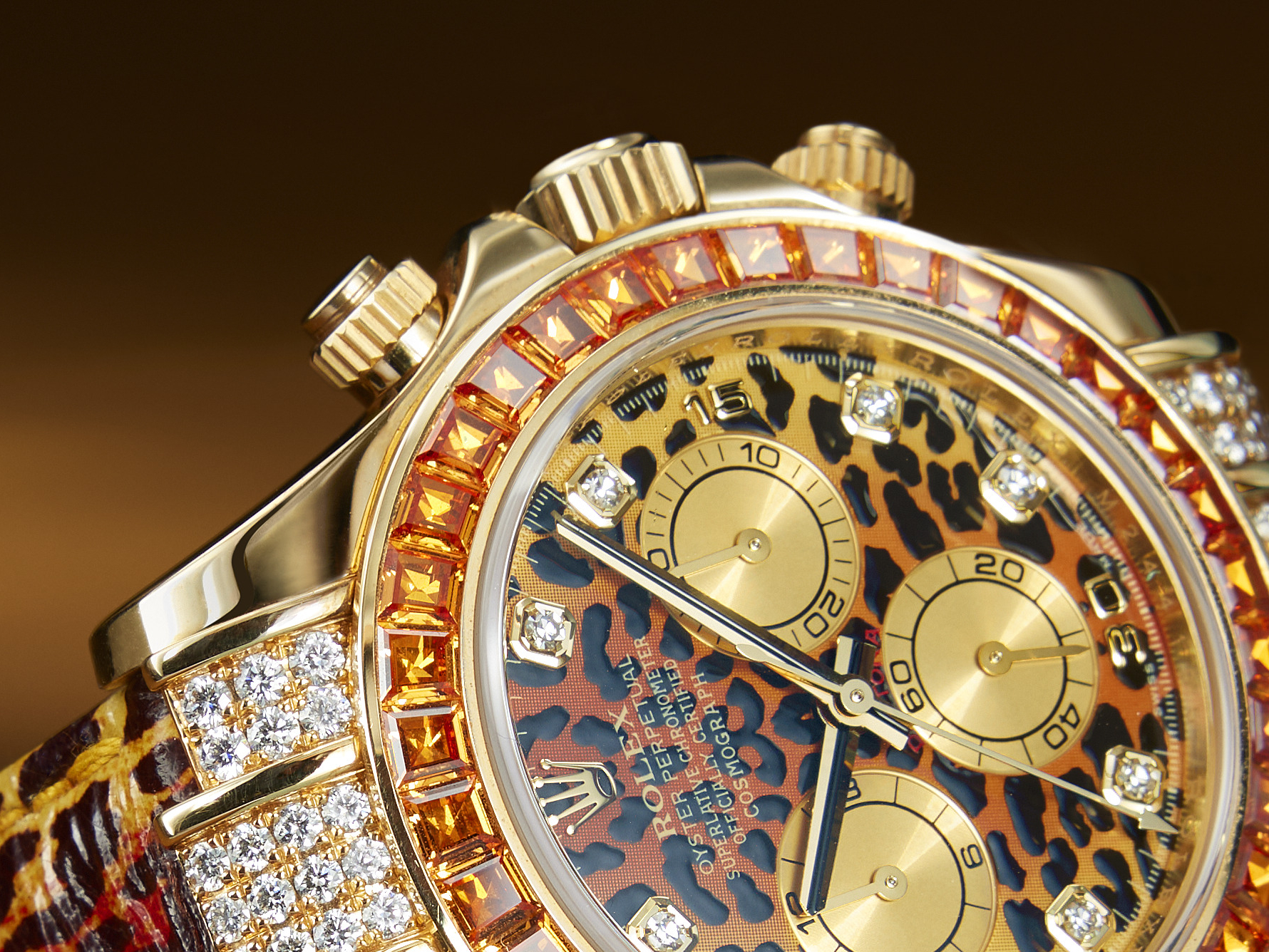
The Leopard plays with the Daytona's learned visual language, as its 40mm 18k yellow-gold case maintains the familiar lines known intimately, yet the execution transforms the silhouette into something theatrical. Where one expects a tachymetric bezel, Rolex instead set thirty-six baguette-cut cognac sapphires (indicated by ‘SACO’ in its reference number) in a circular blaze. These rich, fiery tones shift under varying lighting conditions. This burst of gemstone energy is supported by diamond-set hooded lugs, with forty-eight brilliant-cut stones arranged to resemble the claws of a leopard gripping its frame. With the Leopard, the Daytona’s voice, whose origins are long associated with timing laps, has transformed into a spectacle before the dial is even considered.
A Dial That Walks the Line Between Symmetry and Spectacle
Lacquered in a leopard print design, the dial of the 116598SACO is both provocative and subtly symmetrical. A black lacquer pattern sits atop amber, gold, and an orange gradient, with the motif mirrored down the entire length of the dial. Eight diamond hour markers punctuate the exotic surface, each resting within gold surrounds like artefacts placed in a curated cabinet. The three registers measuring running seconds, elapsed minutes and elapsed hours appear in tonal harmony, further outlined in gold, creating a composition that walks a tightrope between maximalism and choreography. Rolex did not merely add a print; they engineered a display into symmetry.
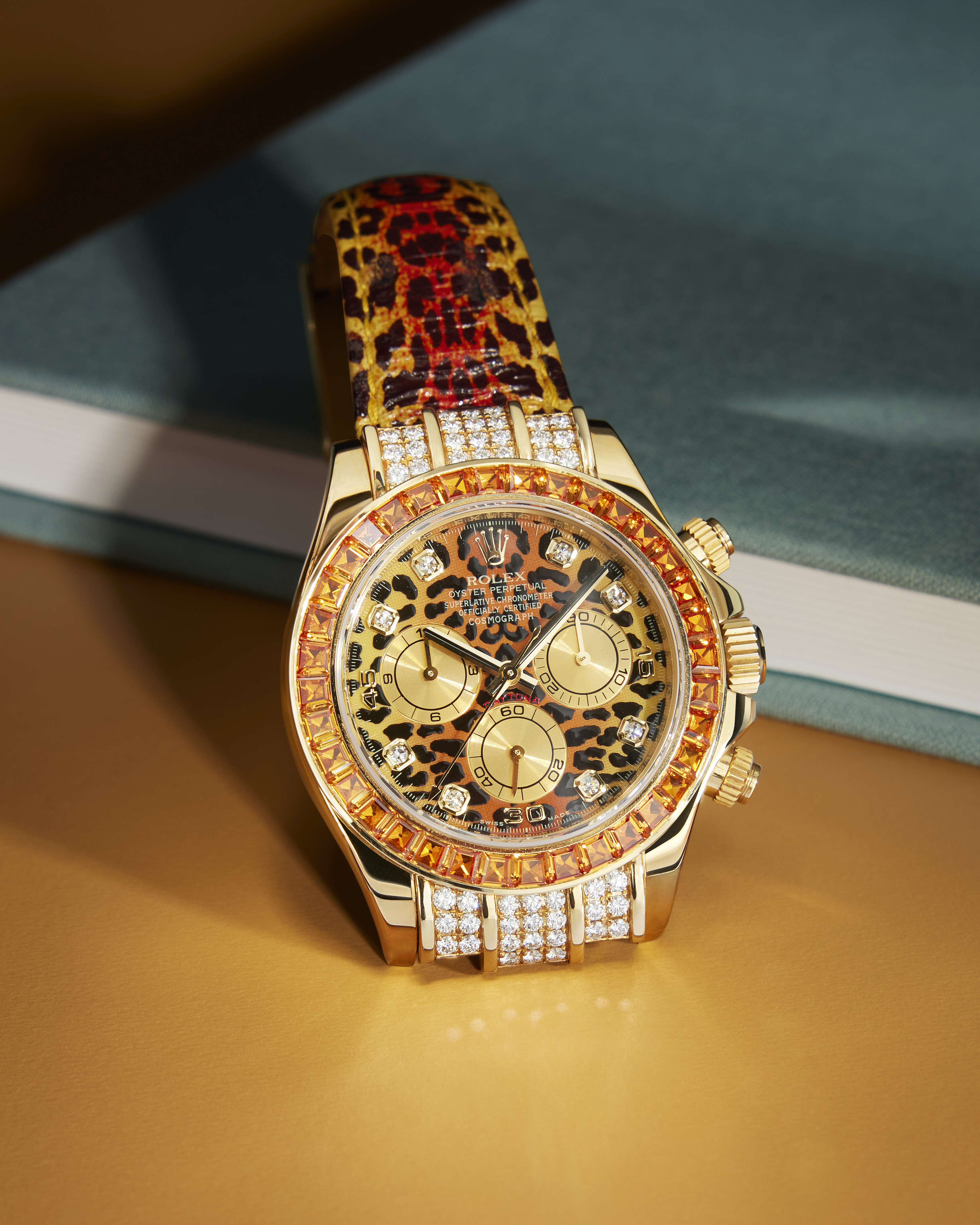
If restraint usually defines Rolex bracelets, the Leopard Daytona breaks the format once more. Instead of metal or the Coronet’s take on a rubber strap in the form of an Oysterflex, the Leopard is paired with a matching leopard-pattern leather strap. Few original Rolex straps compare to the audacity and commitment of this leopard strap, and it's likely few ever will.
As time has repeatedly proven, watch culture has a habit of reframing boldness. What once was perceived as unorthodox began, slowly, to reveal its intentionality. Upon launch, the Leopard Daytona flourished not through mass acceptance but selective admiration. Its scarcity helped as limited uptake inadvertently created rarity. More crucially, the Leopard attracted different voices: collectors into the broader fashion world, celebrities who appreciated theatre, and those who viewed wristwear as cultural expression rather than purely horological seriousness. For them, the Leopard was not a departure; it was resonance.
Gem Setting and Colour Composition in the Daytona’s Sapphire Bezel
The orange-cognac baguette-cut sapphires set into the bezel of this Rolex Daytona radiate a vivid, fire-driven intensity. Each sapphire was carefully selected by gemmologists and set with the highest precision by gemstone setters, creating a flawless gradation that extends seamlessly around the setting. The orange hue is perfectly graduated from stone to stone, producing a continuous and harmonious play of light.
Each of the 36 sapphires is perfectly cut to fit its specific position on the bezel. Its facets are polished to guide light deep into the stone before returning it in luminous reflections. The colour arises from the sapphire’s specific corundum structure: iron provides the dominant yellow tones, while traces of chromium introduce subtle red undertones, giving the sapphire its orange-coloured depth.
Within the sapphires, we encounter the most imaginative interior designs thanks to their unrivalled variety of healing properties. Natural inclusions bear witness to millions of years of geological formation and have been preserved like nature's fingerprints. The watch pays homage to nature itself: through the millennia-old inclusions in its sapphires, it reflects the passage of time both inside and out.

From Curiosity to Cultural Statement
One question remains: why does this watch today hold space alongside tool-grade COMEX pieces, double-signed dials, or Rainbow Daytonas? Because in its loudness lies Rolex’s quiet innovation. The Leopard Daytona represents a pivot, perhaps even a risk: that the brand most synonymous with utilitarian luxury could lean into performative luxury without losing itself. Where collectors often preach minimalism, the Leopard insisted that maximalism has its place too and that confidence is as legitimate an asset as capability.
In a broader cultural arc, the Leopard Daytona charts the intersection between horology and striking self-expression. Watches that spark conversation often age into symbols, specifically as they reveal the boundaries of taste at the time of their birth. The Leopard Daytona is a reminder that Rolex has consistently tested its own philosophy. Beneath diamonds and print, a brand asks whether its identity could contain more than restraint. The answer, it seems, was yes.
Its legacy now sits somewhere between rarity, audacity, and evolution. The Leopard refuses neutrality, a watch that cannot be quietly owned, only embraced. And perhaps that is its truest narrative: the Leopard Daytona is a declaration. One that roared before the world knew how to listen, and now, in hindsight, sounds uncannily like foresight.