Curated Originals
The Gem Set GMT Master II Trilogy
Welcome to 'Curated Originals', a series by Bucherer that showcases extraordinary and significant timepieces and contextualises why they are revered, celebrated pieces in horology today. The series will dive deeper into less common and seldom-seen watches to uncover the essence of their elevated status within culture today.
5 Minutes

Some watches invite lasting fascination, especially when they offer more than rarity alone. What truly sets a piece apart is the way exclusivity is paired with technical or artistic depth. While Rolex remains one of the most significant watch brands today, the Coronet finds ways to produce extremely limited creations embodying this intrigue. Crafted in exceptionally small numbers, certain models are produced away from the public eye which celebrate the brand’s savoir-faire for gem setting using their most iconic designs as the canvas. The gem-set GMT-Master II references 116769, 116758, and 116748 each reflect Rolex’s ability and place within watchmaking, transforming a once utilitarian design into distinct technical aptness, architectural precision, and expressive colour.
In the mid-20th century, as intercontinental jet travel made it possible for passengers to cross oceans in hours rather than days, Pan American World Airways requested Rolex produce a watch for them, one that could help its crews manage time across multiple zones. Rolex accepted the challenge and responded with the GMT-Master in 1955. Distinguished by a 24-hour hand working in concert with a rotating bezel calibrated to track day and night hours, the watch has since transcended its utilitarian origins to become one of Rolex’s most celebrated sports watches.
The references we explore today, however, move far beyond function. These gem-set iterations transform the GMT-Master II, showing Rolex’s ability to marry its technical performance with the artistry of precious stones.
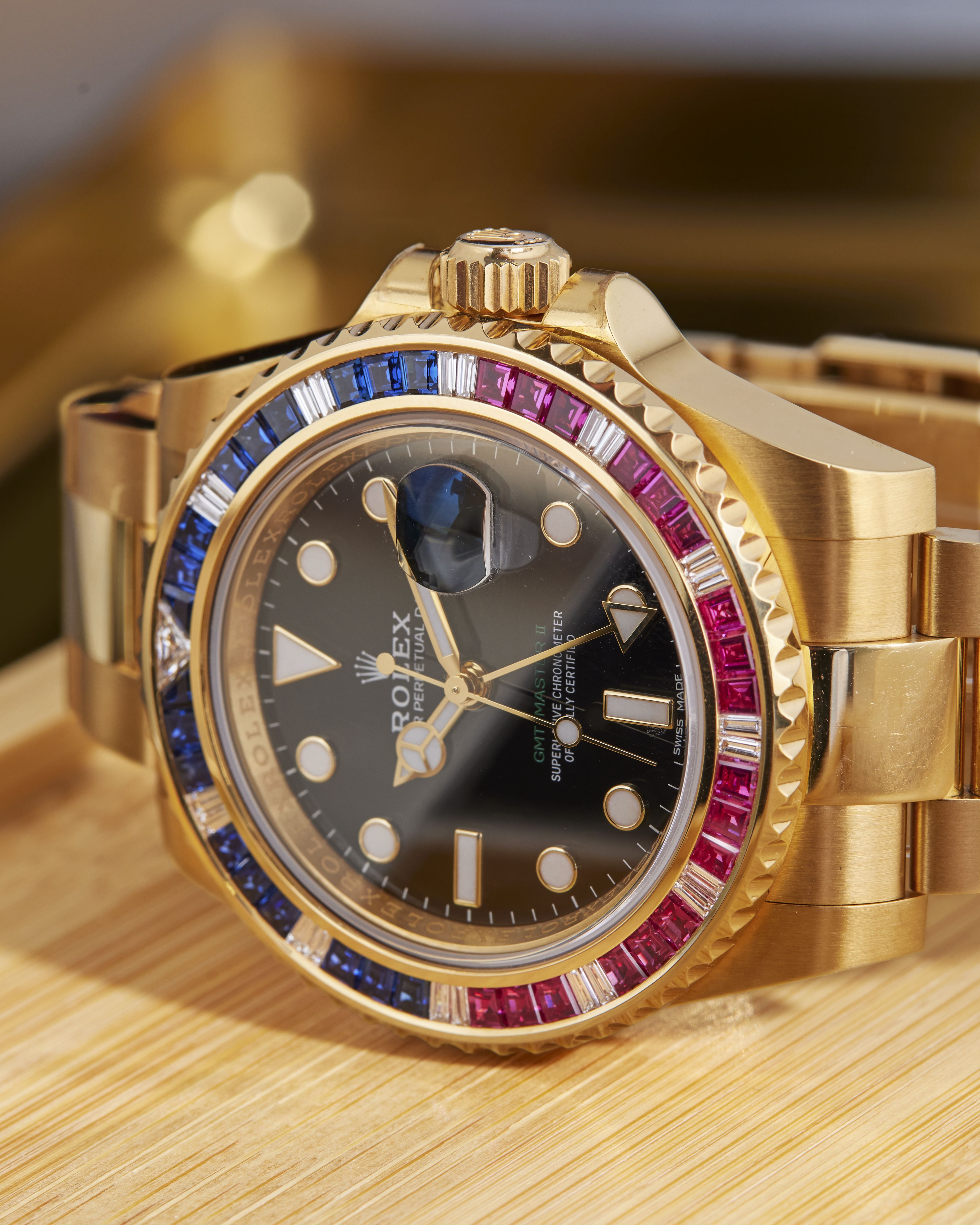
The ref. 116748 is arguably the reference out of the three which maintains the closest resemblance to the conventional GMT Master II models many know the watch for. Rendered in yellow gold, the only inclusion of stone setting is within its bezel, which features a graduation of sapphires, rubies, and diamonds. Known colloquially among collectors as the “SARU” (with 8 sapphires, and 18 rubies, and 23 diamonds), it embraces colour and theatre in a way that few Rolex models ever have. Here, the GMT’s functional bezel is transformed with the addition of masterful stone setting, proving just how far the model’s DNA can be stretched while remaining not only instantly recognisable but capable of maintaining an element of functionality.
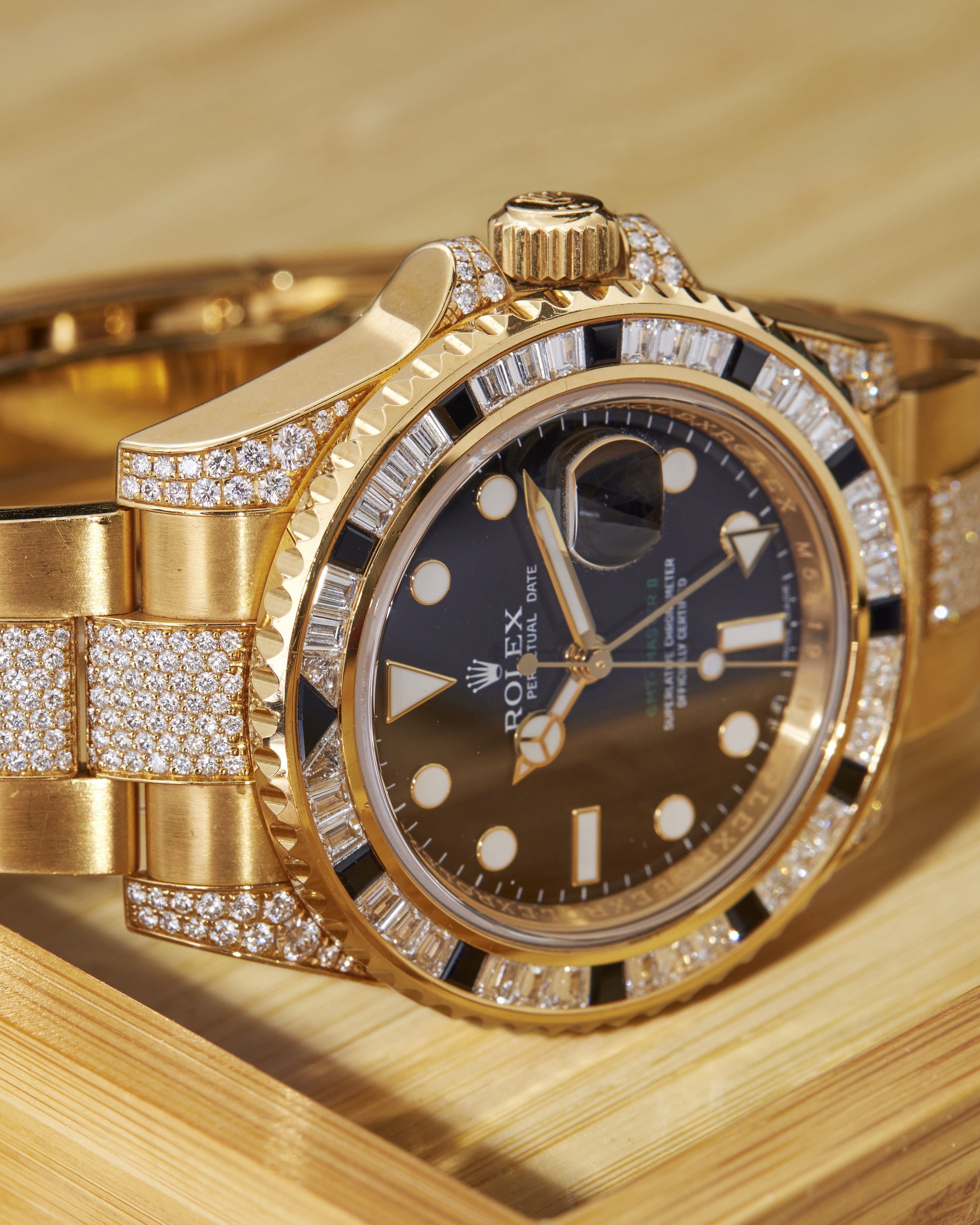
The ref. 116758, in yellow gold, delivers a slightly different interpretation. Its bezel delivers the inverse of the 116748, as trapeze-cut diamonds and black sapphires for what would conventionally be the 24 hour scale, create a remarkable interplay of contrast and rhythm. Additional diamond setting on the lugs and crown guards, and entire centre links with 700 brilliant cut diamonds throughout the bracelet ensures the significance of the watch is visible from every angle, still while maintaining the underlying structure of the GMT. It is a reference that balances its sporty lineage with ornamentation with flair, appealing to those who appreciate the dual identity of a watch that is both an instrument and a visual celebration.
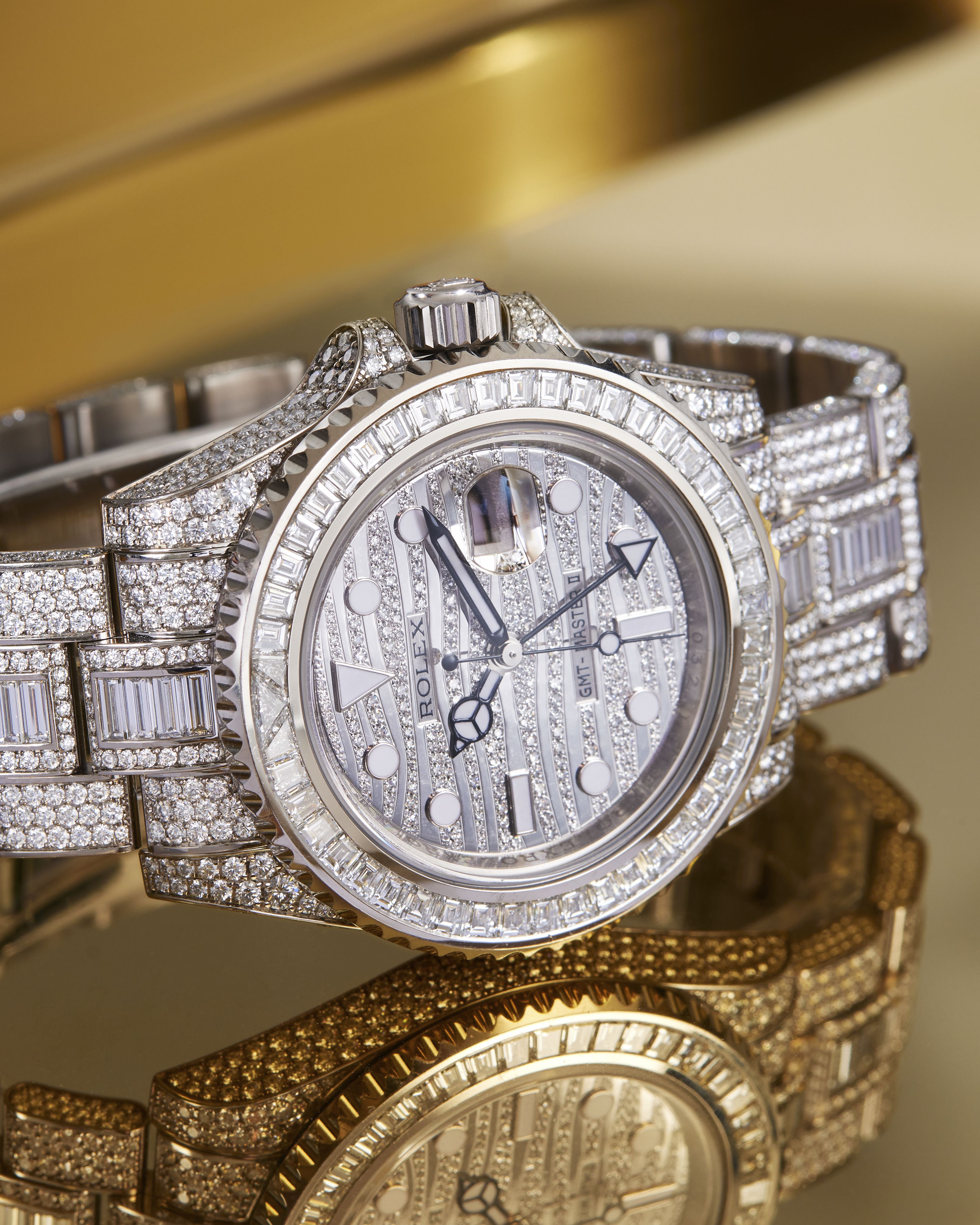
Lastly, the GMT-Master II ref. 116769 is undoubtedly the most grand execution of the model. Exceedingly rare this white gold iteration of the travel watch is adorned with diamonds throughout every surface in sight. The watch is fully pavé-set with 2,000 diamonds, extending across the case, bracelet, dial, and bezel. Unlike any other piece, this design strips away the visual cues of a pilot’s tool and instead reframes the conversation of the GMT as a masterpiece of gem-setting. Every stone is selected for uniformity, brilliance, and placement, creating an uninterrupted canvas of light. The dial also incorporates a wave-like horizontal striping that provides further visual movement to the piece’s presence in a manner few other watches do.
Integrating gemstones into a watch isn’t simply a matter of decoration; it’s a structural challenge. Every facet of the case, bezel, and bracelet is reconsidered to create the foundation for precise stone setting. The tolerances that define Rolex’s engineering leave no room for compromise; even the slightest deviation in thickness or alignment could disrupt symmetry and performance. What makes these watches truly noteworthy isn’t only the brilliance of their stones, but the hidden complexity required to retain the same level of robustness and waterproofing expected of a professional-grade Rolex. Its high jewellery is built upon the uncompromising principles of tool watch design.
Together, these three references illustrate a rare branch of Rolex’s modern history, timepieces that embody some of the brand’s most creative and technically accomplished work. Their status adds another layer of allure, leaving pieces of enigma. Arguably, aside from the apparent beauty and high jewellery mastery on show by Rolex, what makes these creations truly compelling is the juxtaposition they embody. Beneath the diamonds, sapphires, and rubies lies the same engineering and reliability that define Rolex’s sports watches. Yet on the surface, they are unapologetic in their celebration of the GMT and intent to push beyond the practical origins. They are, in essence, both sides of Rolex’s identity, perpetual functional legitimacy paired with remarkable luxury.