A CELEBRATION OF HAUTE HORLOGERIE
A Study in Complication: The Blancpain Six Masterpieces
In the aftermath of the Quartz Crisis, much of the Swiss watch industry was focused on survival. Electronic watches had reshaped the market, consumer priorities were shifting, and traditional mechanical watchmaking suddenly appeared outdated to many. Yet during the 1980s, Blancpain took a very different approach. Under the direction of Jean-Claude Biver and Jacques Piguet, the revived brand positioned itself against the idea that traditional horology no longer mattered.
8 Minutes

Rather than competing on quartz technology, Blancpain entirely embraced mechanical watchmaking, placing complicated movements at the center of its identity. Over the course of the decade, the brand would unveil what would later become known as the “six masterpieces”: ultra-thin, complete calendar moonphase, perpetual calendar, minute repeater, split-seconds chronograph, and flying tourbillon. Together, they formed a remarkably ambitious statement for a newly revived brand, particularly during a period when many still questioned the future of mechanical watchmaking altogether.
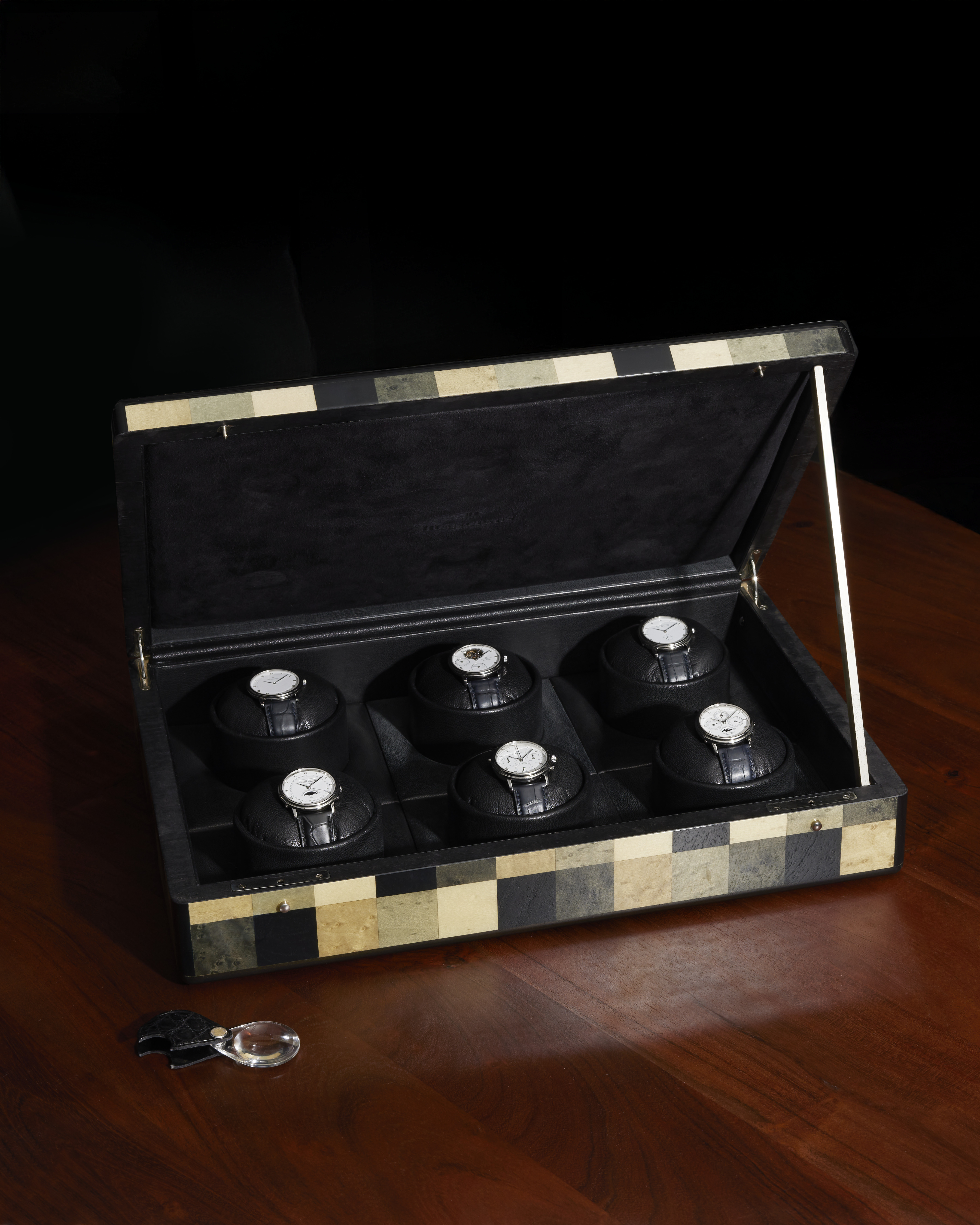
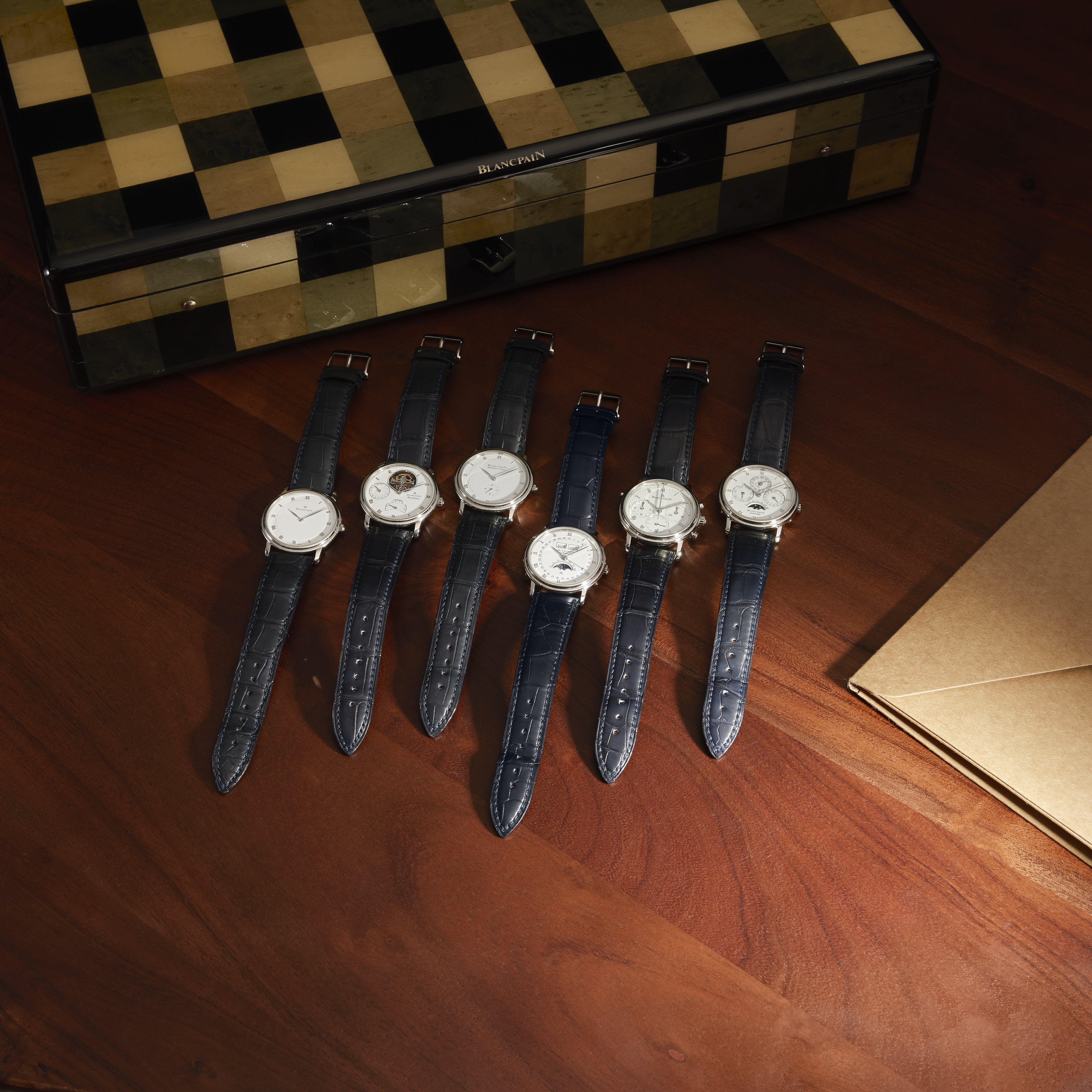
By 1990, Blancpain took the concept even further with the Grand Complication 1735, combining an ultra-thin movement, perpetual calendar, moonphase, split-seconds chronograph, tourbillon, and minute repeater into a single wristwatch. To mark both the achievement of the Six Masterpieces and their culmination in the Grand Complication 1735, Blancpain released a limited series of just 99 complete box sets in 1991, each containing all six masterpieces in platinum and presented in an ornate checkerboard presentation case.
Now available as a complete set by Bucherer Certified Pre-Owned, the Blancpain Six Masterpieces offer a rare opportunity to examine how the brand approached complication during one of the most uncertain periods in modern watchmaking.
Six Watches, One Design Language
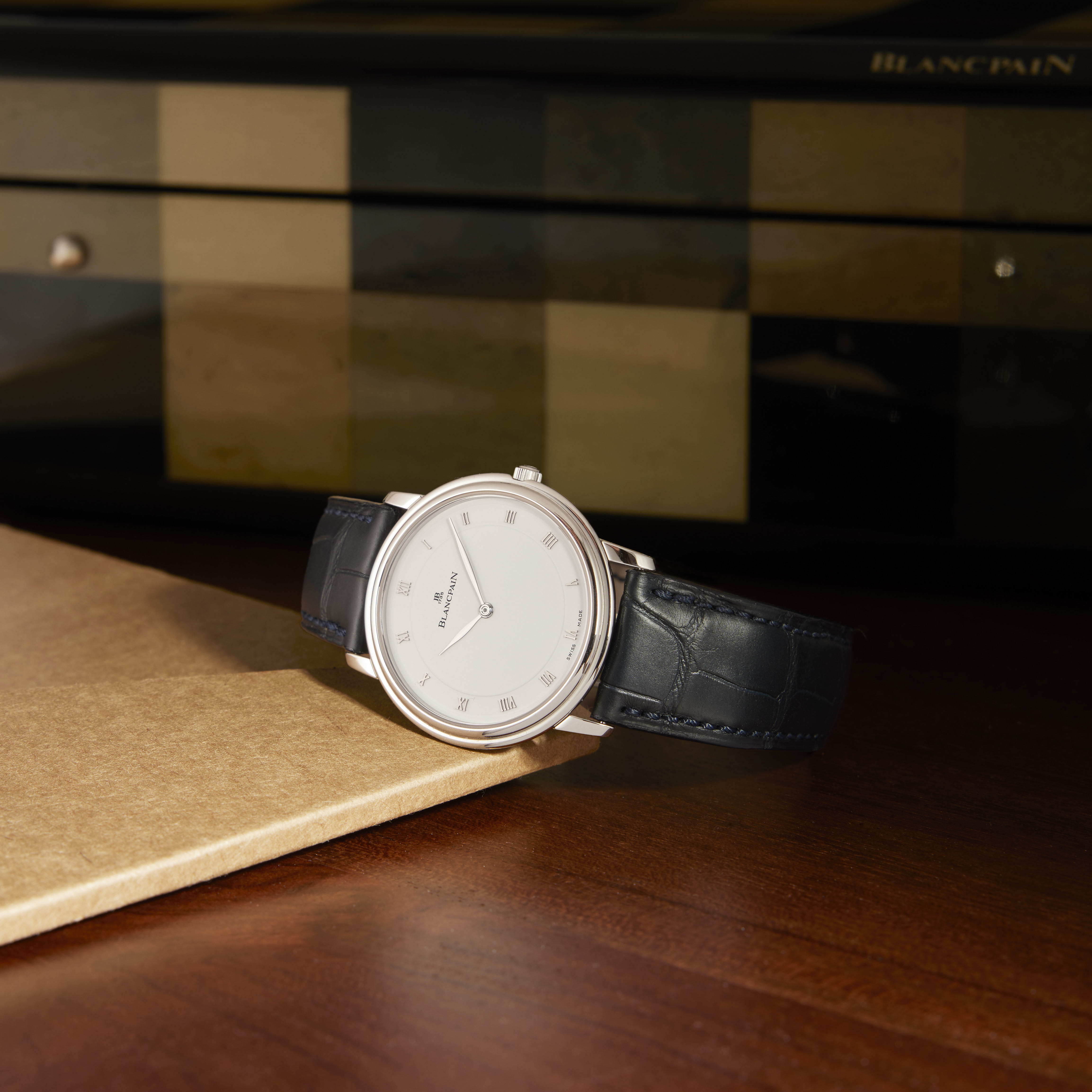
While each of the Six Masterpieces highlights a different complication, Blancpain approached the collection with a consistent design blueprint. Every watch in the set is housed in the same restrained 34mm platinum case, creating a sense of continuity that allows the complications themselves to take center stage. Blancpain relied on a shared framework inspired by the classical proportions and understated character of the Villeret collection.
Several design details unite the six watches. Stepped bezels, slim rounded cases, short curved lugs, and silvered dials establish a traditional aesthetic. Roman numerals, leaf-shaped hands, and delicate chemin de fer minute tracks further emphasize this classical approach, while the use of platinum throughout the set adds quiet prestige.
Within that shared architecture, however, each complication changes the character of the watch entirely. Some dials remain clean and symmetrical, while others become denser with information or mechanical animation. In certain references, the complication introduces a sense of poetry and romance; in others, it emphasizes technical precision or acoustic complexity. The consistency of the cases, therefore, becomes part of the appeal, clearly illustrating how the dial layout has to accommodate the complication. The Six Masterpieces set is a study of how complications shape watch design.
Because these Blancpain Six Masterpieces are part of the limited-edition set, the casebacks are engraved with their production number out of 99 pieces.
Ultra-Thin Ref. 0021
Introduced in 1984 as the second of the Six Masterpieces, the Blancpain reference 0021 demonstrated that technical achievement in watchmaking was not limited to adding functions. In this case, the challenge was achieving slimness.
At the heart of the watch was the Frédéric Piguet Calibre 21, a hand-wound movement measuring just 1.75mm thick. Originally developed decades earlier, the calibre had once held the title of the world’s thinnest mechanical movement, and Blancpain’s decision to revive it reflected the brand’s growing emphasis on traditional Swiss watchmaking.
Producing an ultra-thin watch requires a very different type of engineering than building complications. Components must be reduced in height without compromising reliability, tolerances become increasingly unforgiving, and even small adjustments in construction can dramatically affect performance.
The Blancpain Ultra-Thin is also the most restrained watch within the collection. Its clean dial, slim profile, and absence of additional displays place full emphasis on proportion and execution.
Complete Calendar Moonphase Ref. 6595
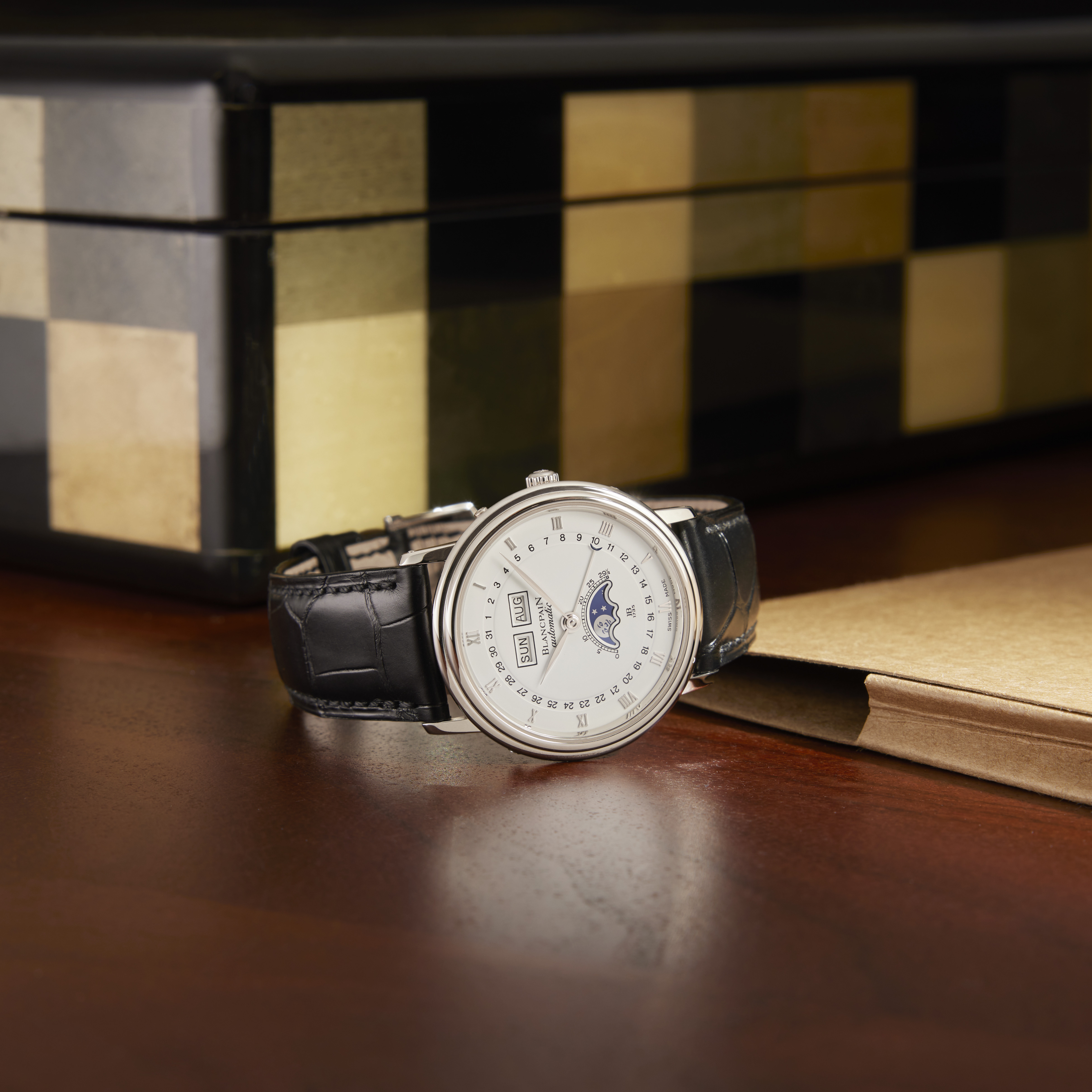
Presented in 1983, the Complete Calendar Moonphase was the first of Blancpain’s Six Masterpieces and, in many ways, the watch that defined the direction of the revived brand. At a time when quartz watches dominated the market, Blancpain chose to lead with a traditionally styled mechanical calendar watch centered around one of watchmaking’s most poetic complications: the moon phase.
A complete calendar displays the day, date, and month, and unlike more complex offerings such as the annual calendar and perpetual calendar, it requires manual adjustment at the end of shorter months. In exchange, the mechanism is generally thinner, less complex, and more approachable in everyday use.
Powered by the automatic Calibre 951 with module 65 mounted on top, Blancpain’s version displays the day and month through twin apertures at 12 o’clock, while the date is indicated by a moon-tipped hand pointing to a peripheral ring of numerals. These indications are accompanied by a moon phase display at 6 o’clock, adding a romantic element that had become increasingly uncommon during the quartz era.
Perpetual Calendar Ref. 5395
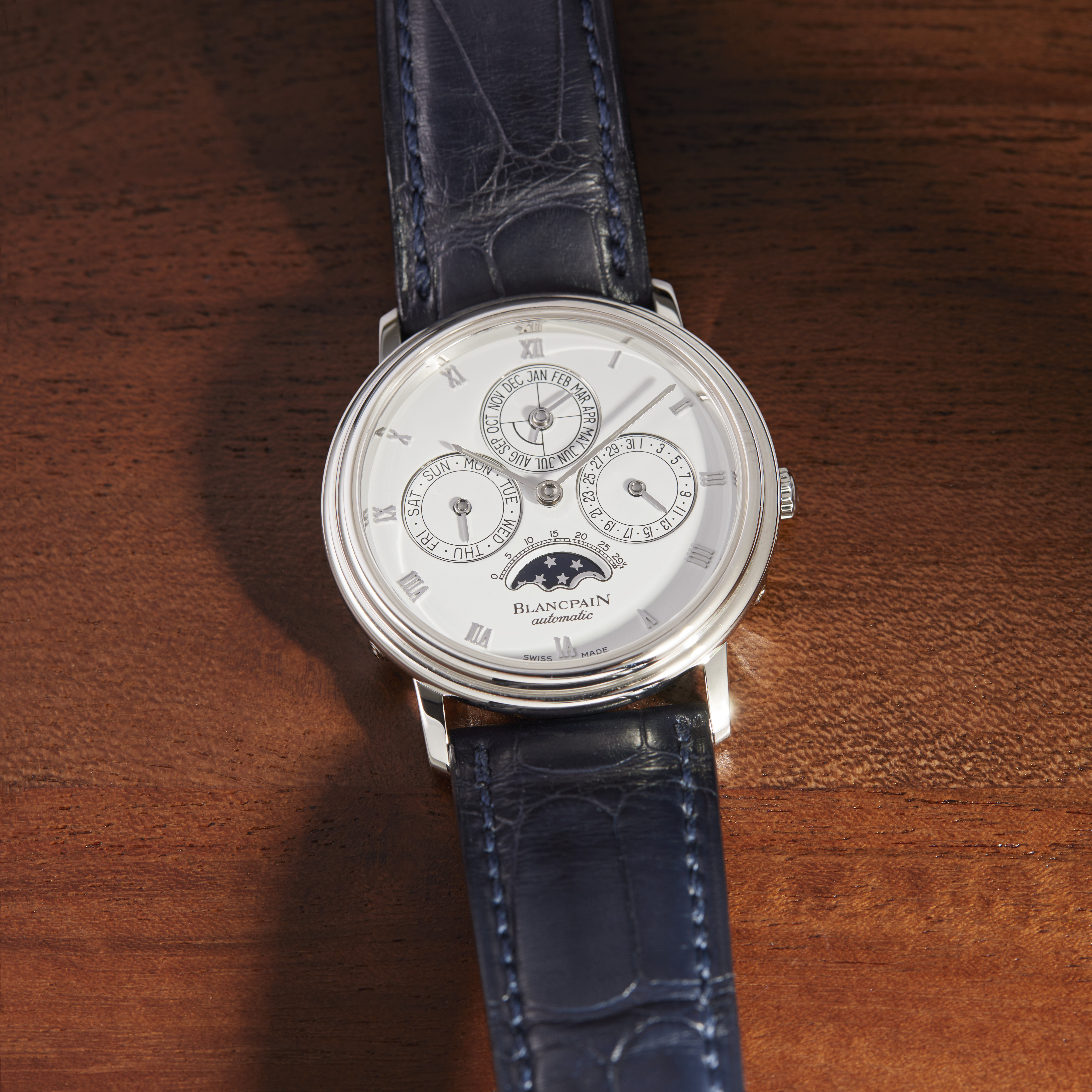
Launched in 1986, the Blancpain Perpetual Calendar ref. 5395 expanded on the foundation established by the Complete Calendar Moonphase while introducing a far greater level of mechanical complexity.
Unlike a complete calendar, which requires manual correction at the end of shorter months, a perpetual calendar is designed to automatically account for the varying lengths of months, including leap years. In theory, the mechanism will remain accurate until the year 2100, when the Gregorian calendar briefly breaks the cycle by omitting a leap year. Achieving this requires an intricate system of cams, gears, and levers capable of mechanically “remembering” the calendar years in advance, placing the perpetual calendar among the most complex watch complications.
This Blancpain Perpetual Calendar paired the self-winding Calibre 95 with a perpetual calendar module to power the timepiece. The date, day, and month are spread across three subdials at 3, 9, and 12 o’clock, respectively, while the lunar display is placed at six. This particular reference did not include a leap year indicator, a feature that would later appear on the ref. 5495.
Minute Repeater Ref. 0033
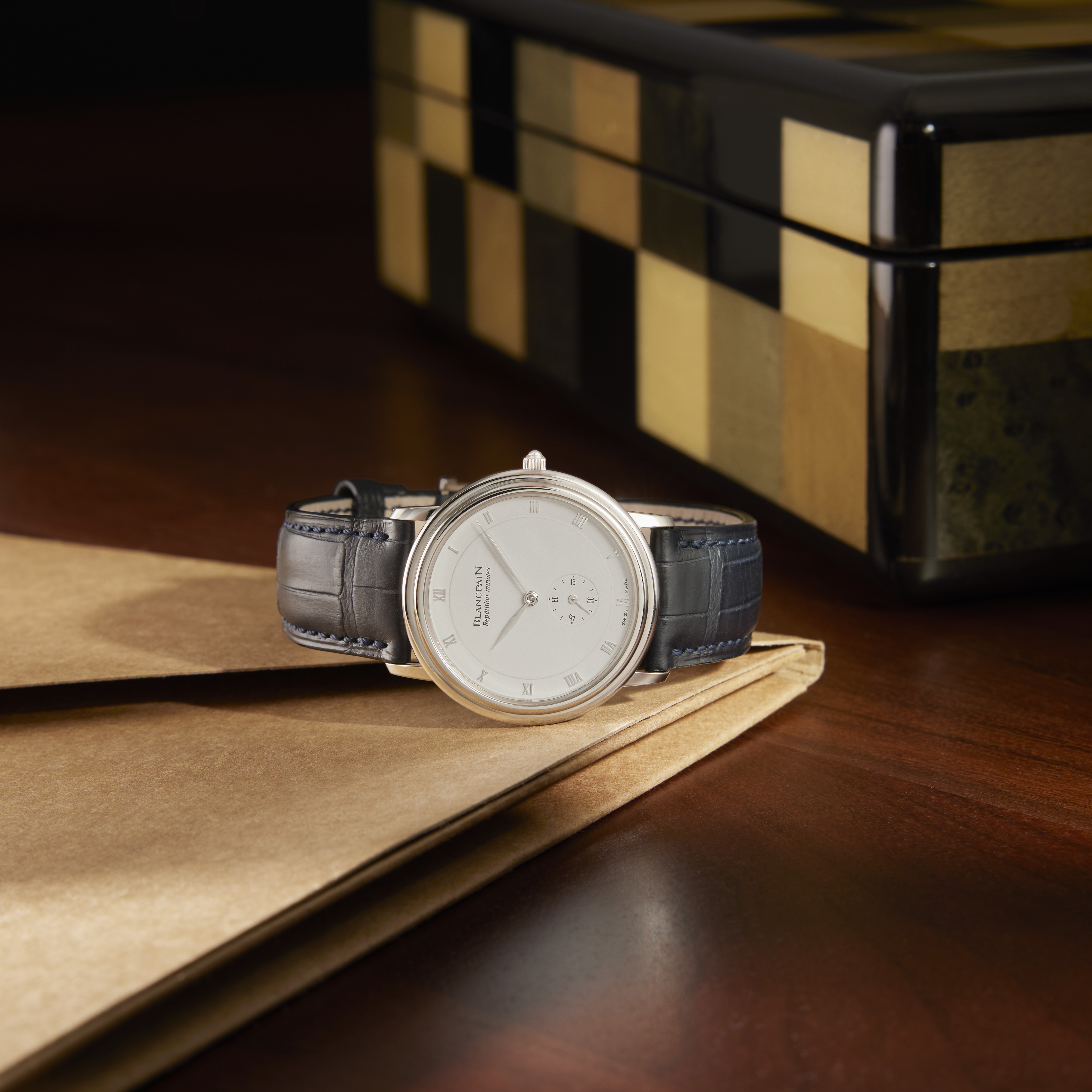
The Blancpain Minute Repeater ref. 0033 was introduced in 1988, showcasing one of the oldest and most technically demanding complications in watchmaking.
Unlike calendar displays or chronographs, which communicate information visually, a minute repeater translates time into sound. Activated by a slide integrated into the case, the mechanism chimes the hours, quarter hours, and minutes on demand using a series of miniature hammers and gongs inside the movement.
Long before electric lighting, minute repeaters were originally developed to allow the time to be read in darkness. By the late 20th century, however, the complication had become less about practicality and more about craftsmanship, acoustics, and mechanical refinement. Producing a minute repeater requires extraordinary precision, as the timing, spacing, and resonance of each component directly affect the sound quality of the chimes.
According to Blancpain, the manually wound Calibre 33 powering the Minute Repeater Ref. 0033 required more than 10,000 hours of development and tuning. At merely 3.3mm thick, it was among the thinnest minute repeater movements of its era.
Blancpain’s design approach to the Minute Repeater remained notably restrained despite the complexity of the mechanism within. The dial simply reads “Répétition Minutes,” avoiding any overt visual indication of the technical sophistication hidden beneath the case. Central hour and minute hands are paired with a small running seconds display at 6 o’clock, preserving the watch’s balanced and highly classical appearance.
Split Seconds Chronograph Ref. 1186
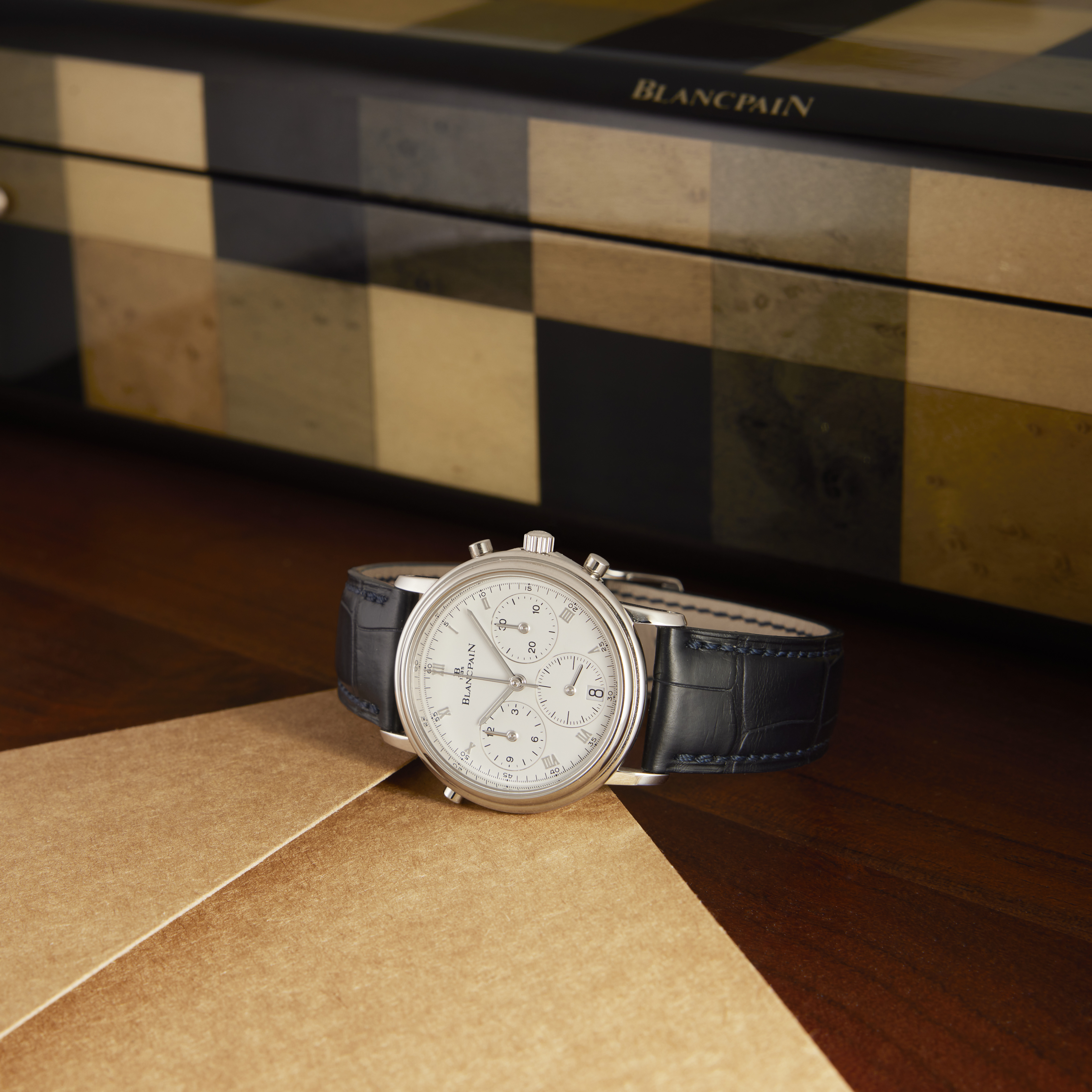
The Blancpain Split Seconds Chronograph ref. 1186, unveiled in 1989, brought one of the most mechanically complex forms of chronograph construction into its lineup. While a standard chronograph is designed to measure elapsed time, a split-seconds chronograph, also known as a rattrapante, adds the ability to time multiple intervals simultaneously.
This is achieved through the use of two centrally mounted chronograph seconds hands placed one on top of the other. When activated, both hands begin moving together around the dial. Pressing the split-seconds pusher stops one hand independently, allowing an intermediate time to be read while the other continues running. Pressing the pusher again causes the stopped hand to instantly “catch up” with the running chronograph hand.
Executing this complication requires an additional layer of clamps, wheels, and isolating mechanisms beyond those found in a conventional chronograph, significantly increasing both mechanical complexity and adjustment requirements.
To create its rattrapante chronograph, Blancpain added a split-seconds mechanism to the self-winding Calibre 1185 chronograph movement, resulting in the Calibre 1186 and, with it, the world’s first automatic split-seconds chronograph movement. The tri-compax dial features a 30-minute counter at 3 o’clock, a 12-hour counter at 9 o’clock, and a running seconds display at 6 o’clock, which also incorporates a date window.
Flying Tourbillon Ref. 0023
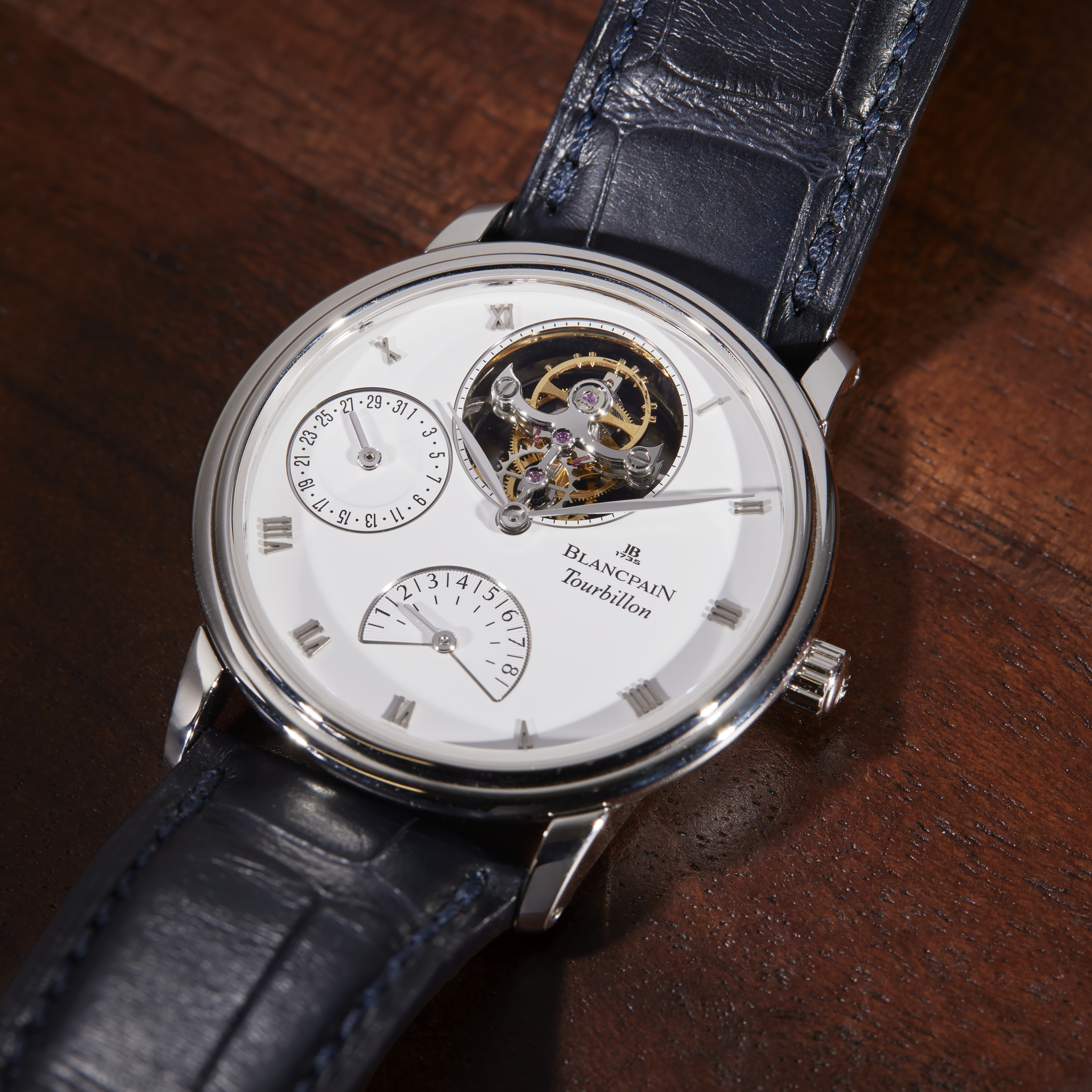
The Blancpain Flying Tourbillon ref. 0023 debuted in 1989, completing the Six Masterpieces collection with one of watchmaking’s most technically demanding complications.
Originally developed in the early 19th century by Abraham-Louis Breguet, the tourbillon was designed to improve accuracy by continuously rotating the escapement and balance wheel within a moving cage, thereby minimizing the effects of gravity on timekeeping.
A flying tourbillon takes the concept a step further. Unlike a traditional tourbillon, which is supported by bridges on both sides of the rotating cage, a flying tourbillon is cantilevered from beneath, leaving the mechanism unobstructed from above. This construction creates the illusion that the tourbillon is floating within the dial while also significantly increasing the technical difficulty of manufacturing and regulating the movement.
Developed in collaboration with independent watchmaker Vincent Calabrese, Blancpain’s Flying Tourbillon ref. 0023 became the world’s first wristwatch to feature a flying tourbillon. To achieve this construction, Blancpain developed a miniature ball-bearing assembly capable of supporting the rotating tourbillon cage from below. The manually wound movement also delivered an impressive 8-day power reserve while remaining housed within a slim 8 mm-thick case.
Aesthetically, the Flying Tourbillon is the most animated of the Six Masterpieces. The flying tourbillon is displayed at 12 o’clock, with a date subdial at 9 o’clock and an 8-day power reserve indicator at 6 o’clock. Central hour and minute hands are paired with a subsidiary seconds display integrated into the tourbillon aperture, allowing the rotating mechanism to serve both a technical and visual function.
Blancpain’s Mechanical Masterpieces
The Blancpain Six Masterpieces capture a pivotal moment in modern Swiss watchmaking. At a time when much of the industry was still reacting to the Quartz Crisis, Blancpain chose to champion traditional mechanical horology through some of its most demanding complications. It was a philosophy perfectly summarized by the brand’s now-famous slogan: “Since 1735, there has never been a quartz Blancpain watch. And there never will be.”
Yet despite the technical ambition behind the collection, the watches themselves remained remarkably restrained, relying on proportion, finishing, and mechanical substance rather than excess.
Together, the Six Masterpieces illustrate not only the breadth of Blancpain’s watchmaking capabilities during the Biver era, but also how complication can fundamentally shape the identity, functionality, and character of a watch.
Decades later, the collection remains an important chapter in the revival of high-end mechanical watchmaking and a compelling example of neo-vintage high horology.