
The Evolution: Rolex Yacht-Master II
The Regatta Chronograph Unlike Any Other
There is a certain dichotomy to the Rolex Yacht-Master II. For all the presence it commands and the technical ambition it represents, it remains one of the most misunderstood watches in the Rolex catalogue. Often overlooked due to its bold styling and highly specific purpose, it can feel distant from the brand’s more sports models. Yet beneath its polished bravado lies one of the most technically complex movements ever produced by the Coronet, a mechanical achievement designed for precision at sea.
5 Minutes

A Complication Designed for Regatta Timing
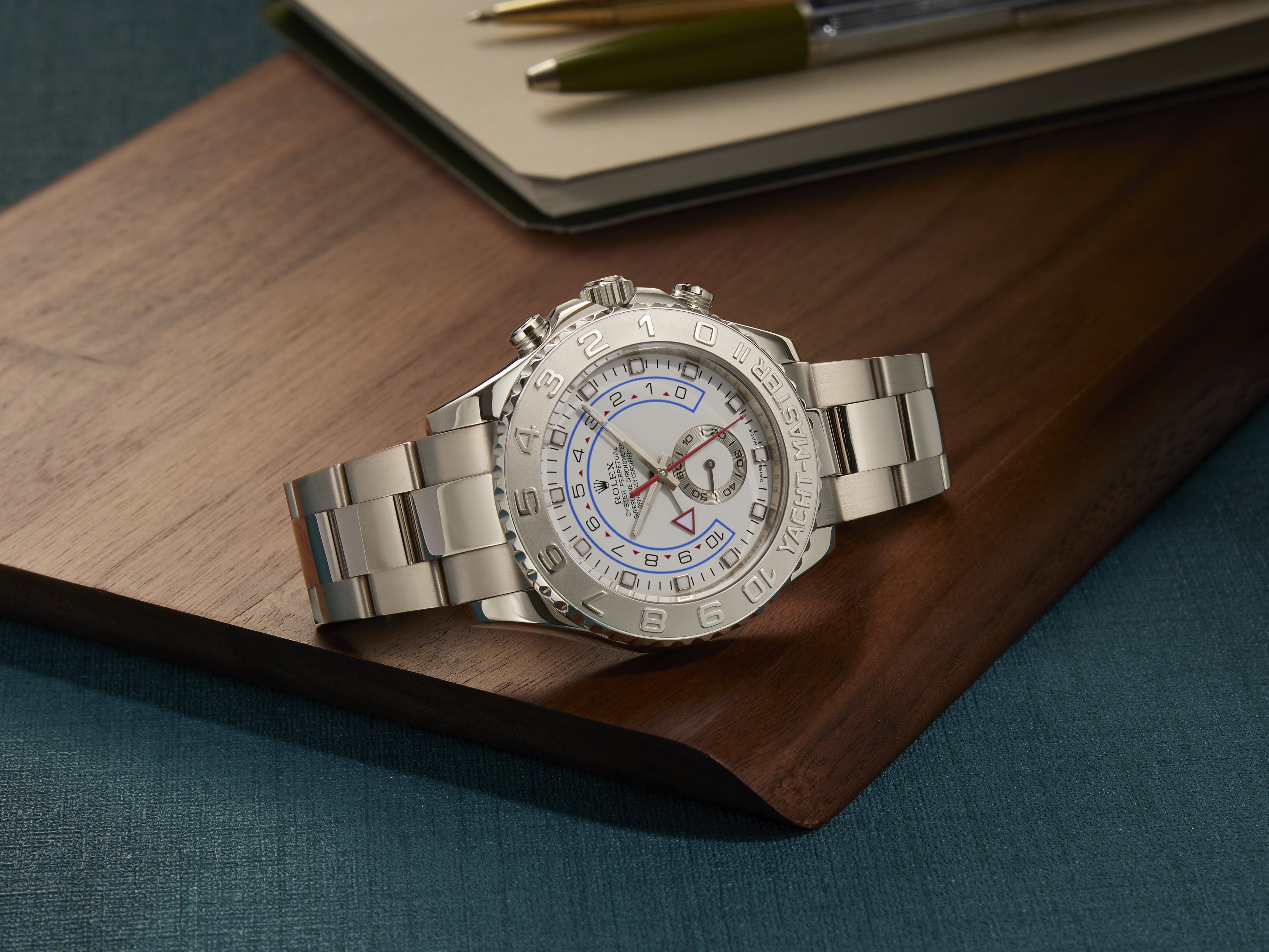
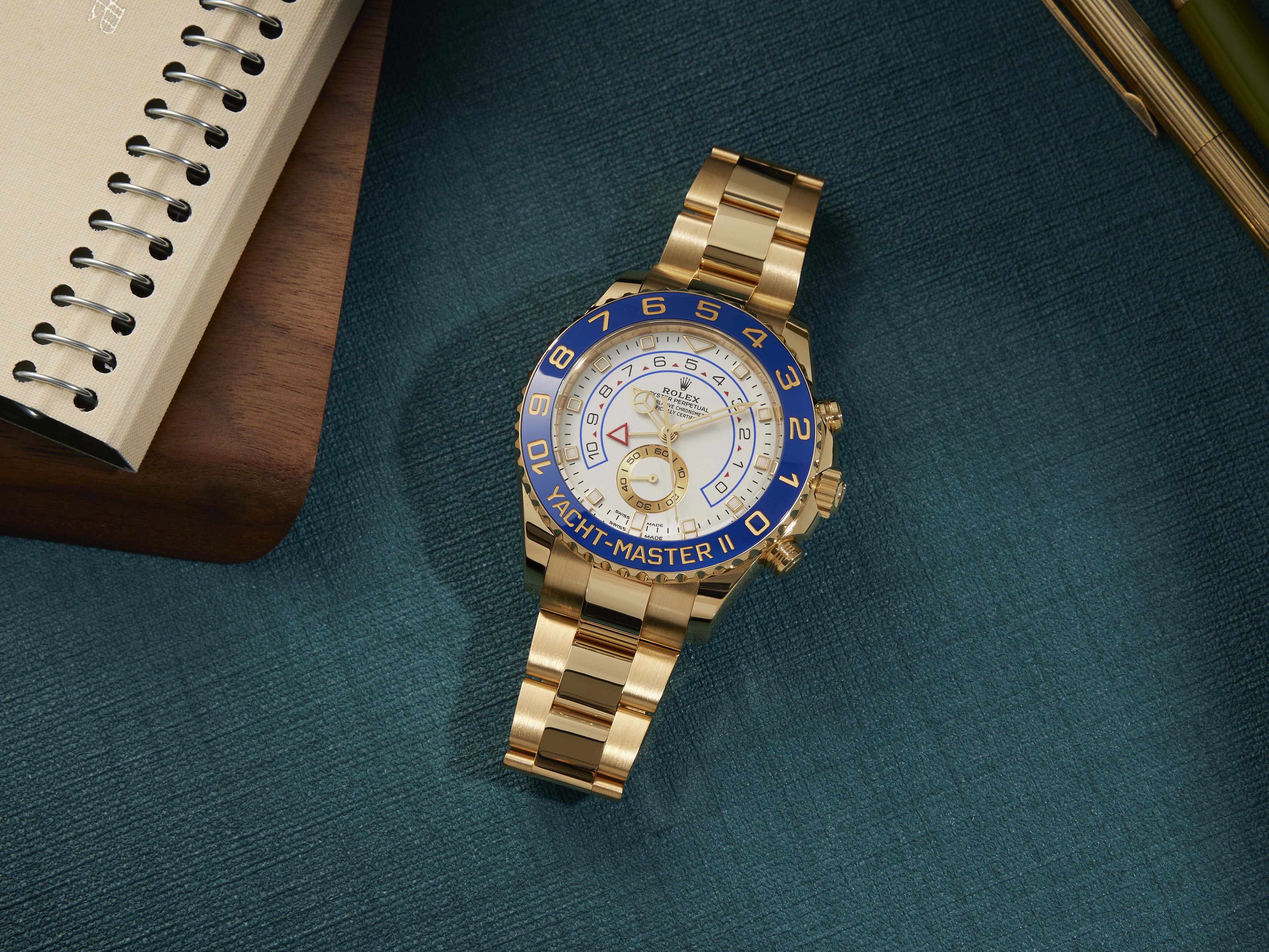
Unveiled in 2007, the Yacht-Master II marked a disruptive moment for Rolex. Rather than refining an existing complication, it introduced something entirely new: a programmable mechanical countdown timer with memory. Built specifically for the intense and time-critical environment of competitive sailing, it was engineered to perform at the starting line of a regatta, where anticipation and positioning are often as decisive as speed itself. The first expression of this idea arrived in full 18ct yellow gold as the reference 116688, an unapologetically bold piece that signalled Rolex’s status in both the complication and as a leading Swiss watchmaker.
The Ring Command Bezel
To understand just how radical the Yacht-Master II was, it helps to look back to the original Yacht-Master of 1992. That watch was conceived as a more refined and luxurious interpretation of Rolex’s maritime identity, connected to the ocean but rarely immersed in it. Polished surfaces, precious metals, and sunburst dials separated it clearly from the Submariner. The Yacht-Master II inverted that philosophy entirely. Instead of softening a tool watch, Rolex created a new instrument from the ground up, one defined by function first and aesthetics second. At the heart of this instrument lies the Ring Command Bezel, one of the most ingenious systems Rolex has ever produced. Unlike traditional bezels, it is mechanically linked directly to the movement. Rotating it engages a series of gears that allow the wearer to set, synchronise, and reset the regatta countdown timer with absolute precision. Once programmed, the timer can be adjusted on the fly and instantly aligned with the official race clock. This mechanical memory system had never before been realised in a wristwatch chronograph and remains unique to the Yacht-Master II. Powering this innovation is the calibre 4161, a movement that reportedly took more than 35,000 hours to develop. Comprising over 360 components, it builds upon Rolex’s experience with the Daytona’s calibre 4130 while introducing an entirely new architecture.
The result is a movement that is robust, precise, and uncompromising, reinforcing the idea that even Rolex’s most visually assertive watches are grounded in engineering discipline. As the Yacht-Master II evolved, Rolex began exploring how this specialised complication could exist across different materials.
From Gold to Steel: Expanding the Yacht-Master II
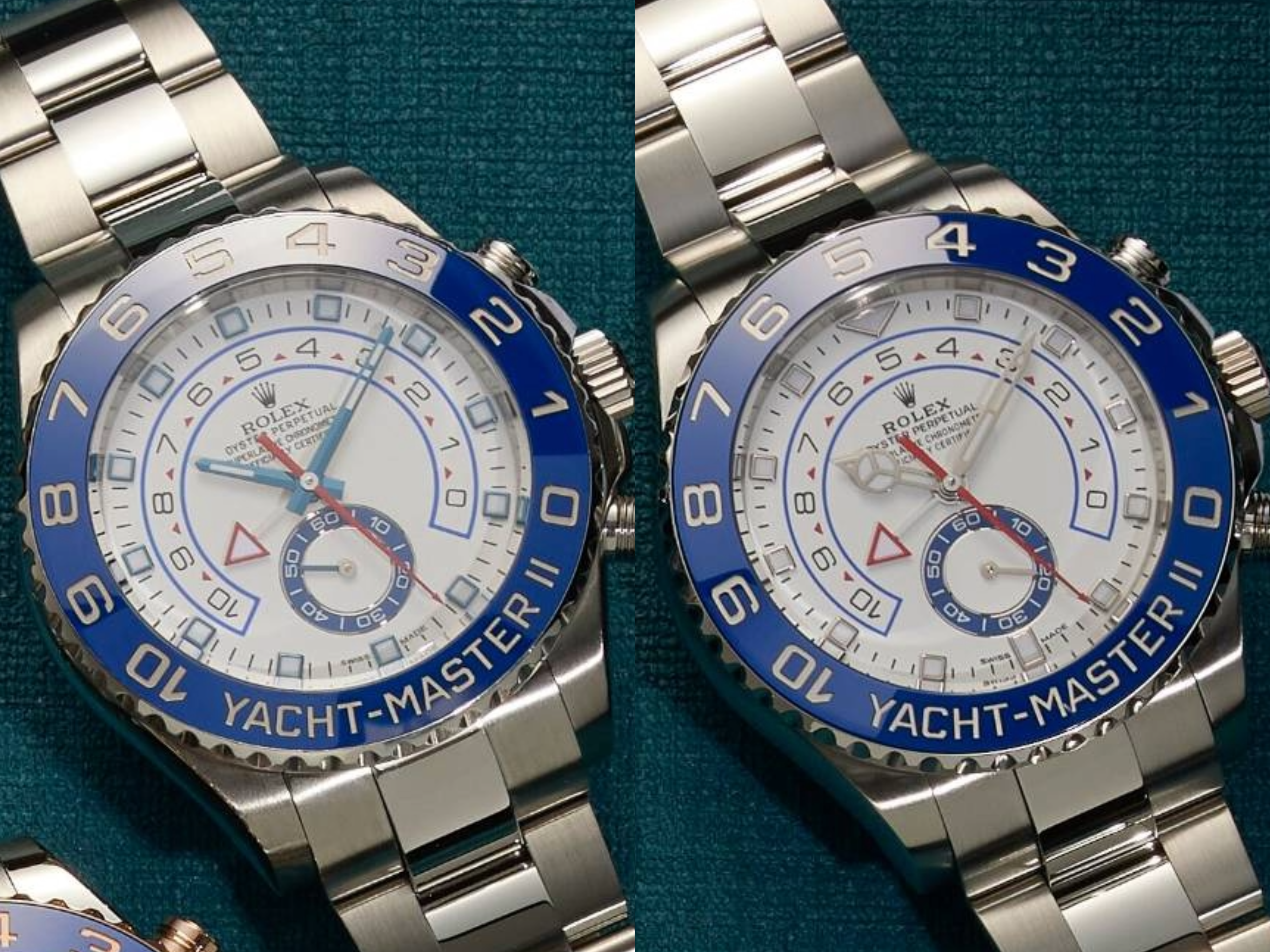
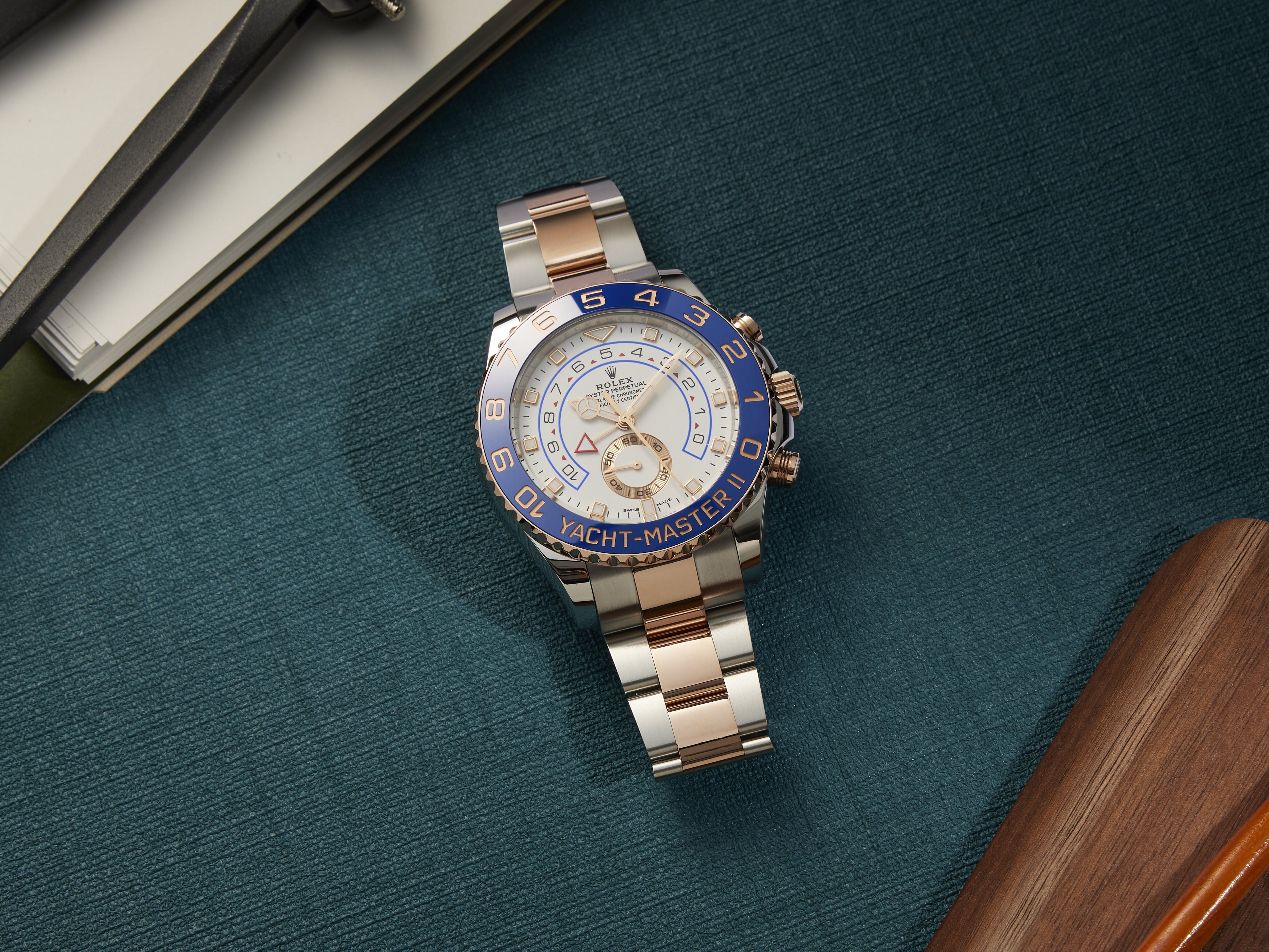
Alongside the yellow gold reference, the brand introduced the Rolesium 116689 in 2007, pairing a white gold case and bracelet with a platinum bezel. More restrained at a glance, this version reveals a subtler form, allowing the technical nature of the watch to direct the conversation. In 2011, the steel and Everose gold reference 116681 followed, pushing the Yacht-Master II further into Rolex’s modern sports-luxury vocabulary. The most overt shift toward practicality came in 2013 with the introduction of the stainless steel reference 116680. This version presented the Yacht-Master II in its most utilitarian form, aligning the regatta complication with a material historically associated with professional Rolex models. Early examples of this first generation are defined by blue hands and indexes, a non-Mercedes hour hand, and a distinctive square marker at 12 o’clock.
From around 2017 onwards, Rolex continued to refine the steel Yacht-Master II, albeit on a more conservative level. Later generations of the 116680 introduced silver hands, the familiar Mercedes hour hand, and a triangular marker at 12 o’clock. These changes brought the watch closer to Rolex’s broader design language while leaving its function untouched.
Despite its roots in regatta timing, the Yacht-Master II has long since transcended its original niche. With its 44mm case, one of the largest in the Rolex family, and a dial that reads more like an instrument panel than a traditional sports watch, it makes no attempt to blend in. Much like many of the brand’s catalogue before it, what began as a specialist’s tool has become a statement of mechanical confidence and intent. Within Rolex’s catalogue, the Yacht-Master II occupies a singular position. It is both a precision instrument and a symbol of modern prestige, bridging the brand’s professional heritage with its contemporary identity. While most Rolex sports watches refine familiar formulas, the Yacht-Master II is one of the few that invented a new one entirely.
There is something poetic about a watch designed to measure anticipation instead of elapsed time. In a catalogue shaped by continuity and precision, the Yacht-Master II highlights Rolex’s capacity to develop new solutions when performance requirements call for it.
Continue reading


