A Century of Tudor, Dressed for the Occasion
Tudor at 100: How to Wear a Century On The Wrist
A hundred years ago, the name “The TUDOR” was registered in Geneva, and it went on to sit on the wrists of polar explorers, naval divers and office workers alike. Built to be used rather than admired from afar, Tudor is best celebrated the way it was always meant to be: on the wrist. So we’ve turned its timeline into a style guide, pairing each defining era, from post-war dress watches to Riviera divers and 1970s racing chronographs, with the wardrobe it belongs to and the modern watch that carries its spirit today.
4 Minutter

Every year the watch industry marks a handful of anniversaries, some celebrating a particular model and others a turning point for particular maisons, but few carry the weight of a centenary. Reaching a hundred years means all the more when the brand in question is Tudor. In February 1926, the name "The TUDOR" was registered in Geneva on behalf of Hans Wilsdorf, the man who had already built Rolex, and his idea was a straightforward one: watches that carried the same durability his other company was known for, made for a far wider world of wearers. Over the century that followed, Tudors were bought to be used, strapped onto the wrists of explorers and naval divers as often as those of office workers.
To make this significant anniversary, what follows is a reframed timeline that pairs moments in Tudor's history with watches from that era, alongside some gentle on-the-wrist advice. After all, a hundred years on, the most fitting way to celebrate a brand built on use is still to put one on and wear it.
The Everyday Watch: The 1930s to the 1950s
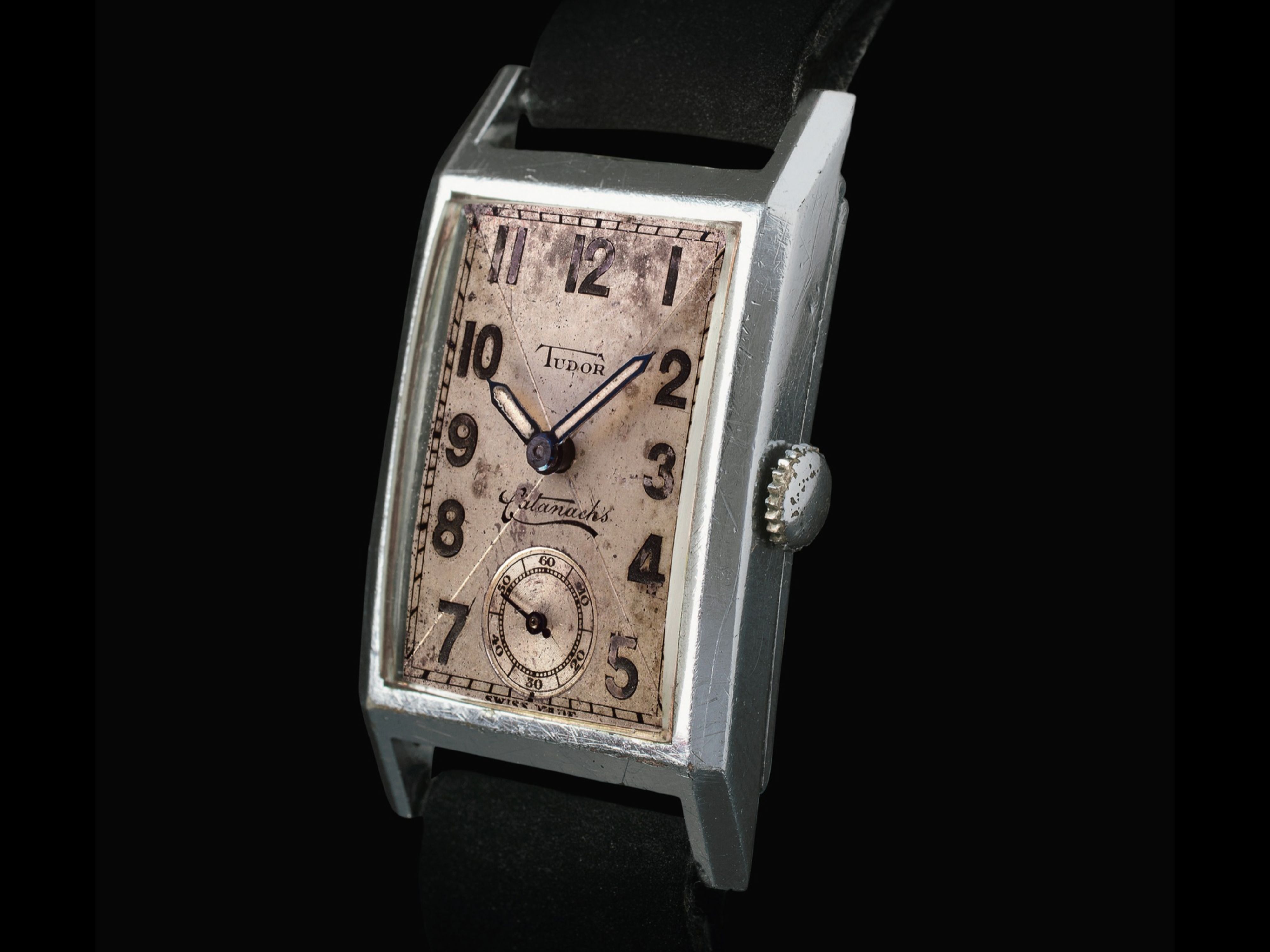
Tudor's first decades were spent making modest, well-built watches for daily life, the earliest often in cushion or rectangular cases signed with a ‘T’ whose crossbar stretched over the rest of the signature. By the post-war years the proposition had settled into references such as the Oyster 7934, a 34mm, manual-wind, time-only watch in an Oyster case that did everything a working man needed and nothing he didn't, and it remains one of the most satisfying ways into vintage Tudor, particularly with the rose on its dial. These watches were made to sit beneath the cuff, and their modest size and period details mean they still suit almost anything, with a lean toward the dressier end, whether that means a grey flannel suit or a navy roll-neck.
Today's equivalent: The spirit of this era lives on most clearly in the Royal, now offered in 30, 36 and 40mm with dials ranging from salmon and blue to mother-of-pearl, with the 36mm closest to those post-war proportions, while the 1926 collection, whose name nods directly to the founding year, offers a little more old-world charm.
The Expedition Wrist: The 1950s and 1960s
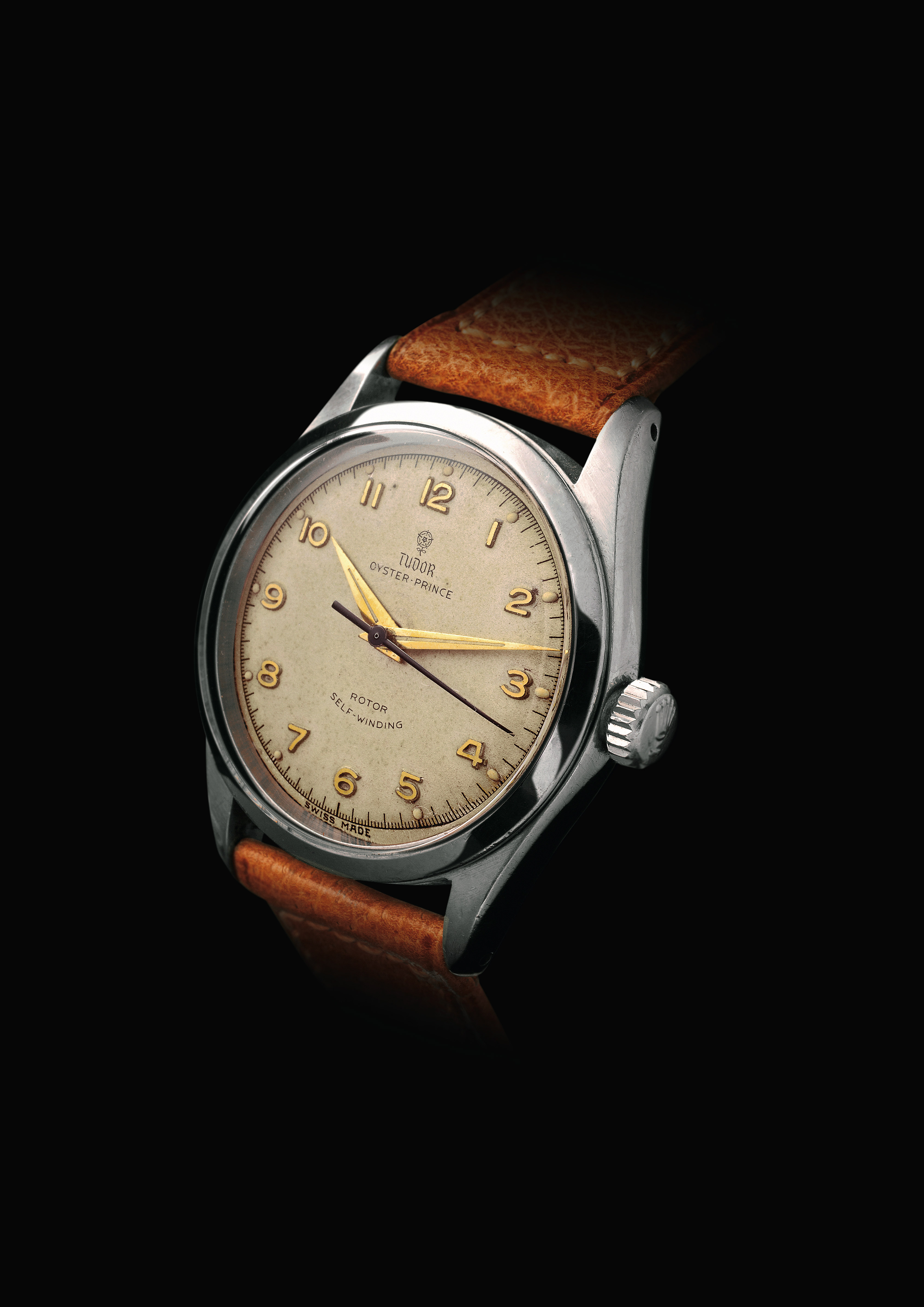
The Oyster Prince arrived in 1952 as Tudor's first self-winding watch in an Oyster case, and that same year examples went north with the British North Greenland Expedition, a two-year scientific mission led by Commander James Simpson of the Royal Navy, whose members logged their watches' accuracy against BBC time signals in temperatures that fell far below anything a watch was expected to endure. Tudor placed this excursion at the heart of its advertising, and that spirit carried into the late 1960s with the Oyster Prince Ranger, reference 7995/0. At 34mm in steel with a matte black dial, luminous Arabic numerals and the rose logo, the model stayed in the catalogue until 1988 and has since become one of the most sought-after vintage Tudors.
The expedition look was wool on wool, an Aran knit under a windproof smock and a duffel coat for the journey home, and by the Ranger's era that practical instinct had filtered into the Harrington jacket, the button-down Oxford and the desert boot, which remain its most natural companions.
Today's equivalent: The modern Ranger is about as faithful a continuation of the 7995/0 as Tudor could have made, keeping the matte black dial and luminous Arabic numerals, available in both 36mm and 39mm, and its real appeal is that it asks nothing of the person wearing it.

The Navy Divers: 1954 to the 1980s
Among collectors, Tudor's Submariner carries particular weight. It arrived in 1954 as the reference 7922, with an Oyster case, a 100-metre rating and the rose on its dial, followed in 1958 by the 200-metre "Big Crown" 7924 and in 1959 by the 7928, whose crown guards set the template for the decade that followed.The Marine Nationale and the US Navy both issued Tudor Submariners to their divers, and in 1969 the reference 7016, alongside the date-equipped 7021, introduced the square markers and angular hands collectors call "snowflake", a design carried into the 9401 of the late 1970s, whose blue-dialled Marine Nationale examples are peak collectible Tudor today.
The Marine Nationale also gave the world the Breton marinière, so the look writes itself: the Côte d'Azur in the late 1960s, a striped top or terry polo, white jeans, boat shoes and a watch that has clearly been in the water that morning.
Today's equivalent: The Black Bay family is where Tudor's diving heritage now lives, and the size selected changes its character considerably. At 37mm via the Black Bay 54 its the closest to the slim proportions of the 7922, while the 39mm Black Bay 58, which gained a GMT version in 2024, is the modern classic everyday choice, and the titanium Pelagos 39 is the lightest and most technical of the three.
From Rose to Shield
Tudor's first watches carried only the name, its T stretched across the other letters, until in 1936 the rose appeared within a shield, the emblem of the English royal house that united Lancaster and York and a nod to Britain, where Wilsdorf had founded his business. By 1947, the shield had gone, and the rose stood alone, until in 1969, as Tudor turned towards tougher and more technical watches, the rose gave way to the shield on its own. It never entirely disappeared, returning to the dial and crown of the first Heritage Black Bay in 2012. Nevertheless, for many, a rose-signed dial remains the most romantic detail a Tudor can carry.
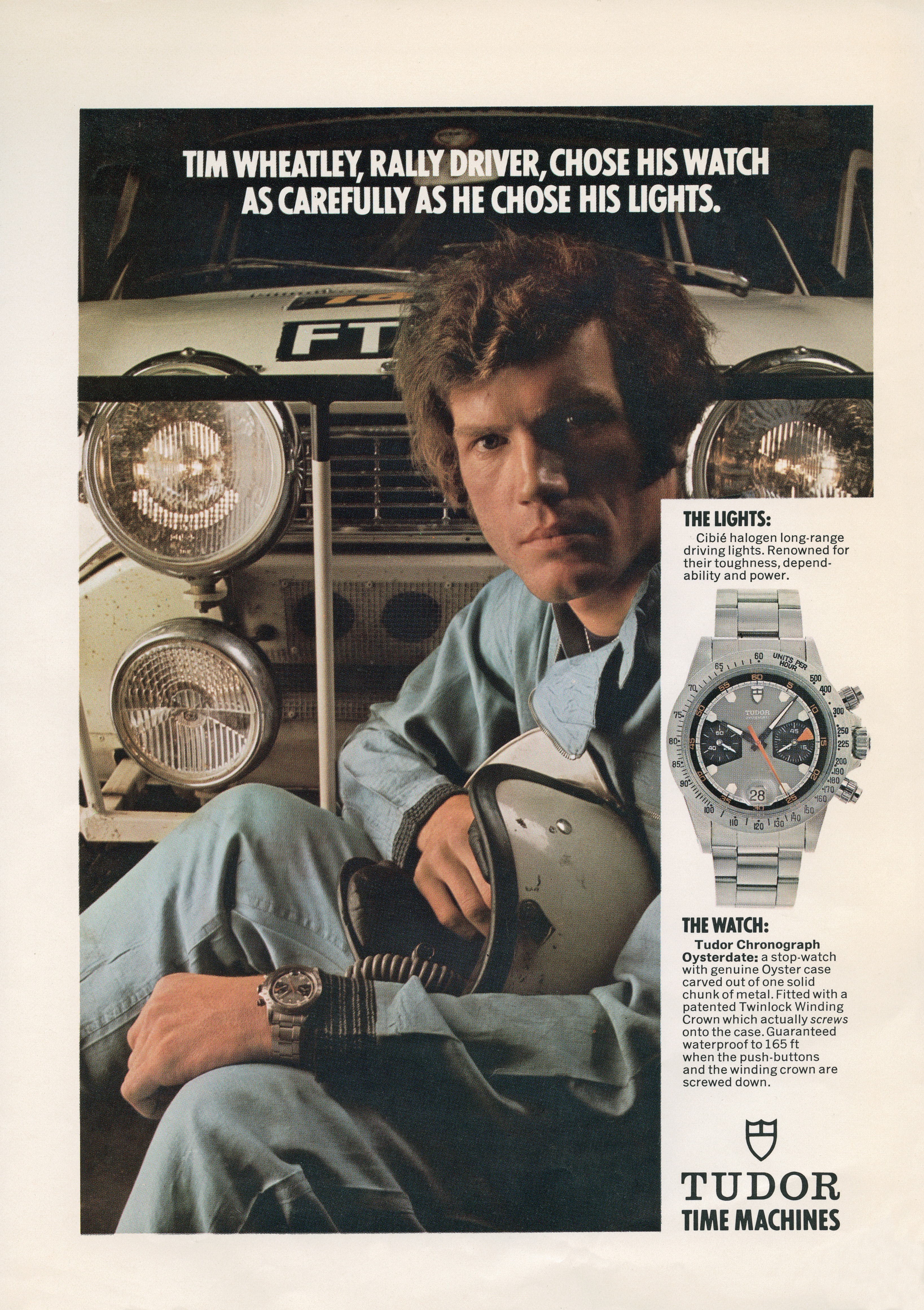
The Racing Chronographs: The 1970s
Tudor's first chronographs arrived in 1970 as the Oysterdate references 7031 and 7032, nicknamed the "Home Plate" for their five-sided hour markers, with 39mm cases that felt enormous at the time, screw-down pushers, a manual-wind Valjoux movement and a grey, black and orange palette that could only belong to that decade. A second series followed in 1971, including the blue-bezelled 7149, whose roulette-table dials earned the nickname "Montecarlo", and in 1976 the self-winding Valjoux 7750 arrived in the 9420, 9421 and 9430, whose thicker cases made them the "Big Block", told apart only by their bezels.
These belong to the 1970s paddock, a snug leather racing jacket or suede blouson over a wide-collared shirt, flared tailoring and driving shoes, worn with the easy confidence that made a bold dial the point of the outfit.
Today's equivalent: The Black Bay Chrono is the heir to the Montecarlo and the Big Block, with panda dials that owe an obvious debt to the originals, and while it wears larger and thicker, a racing chronograph was never meant to be discreet.
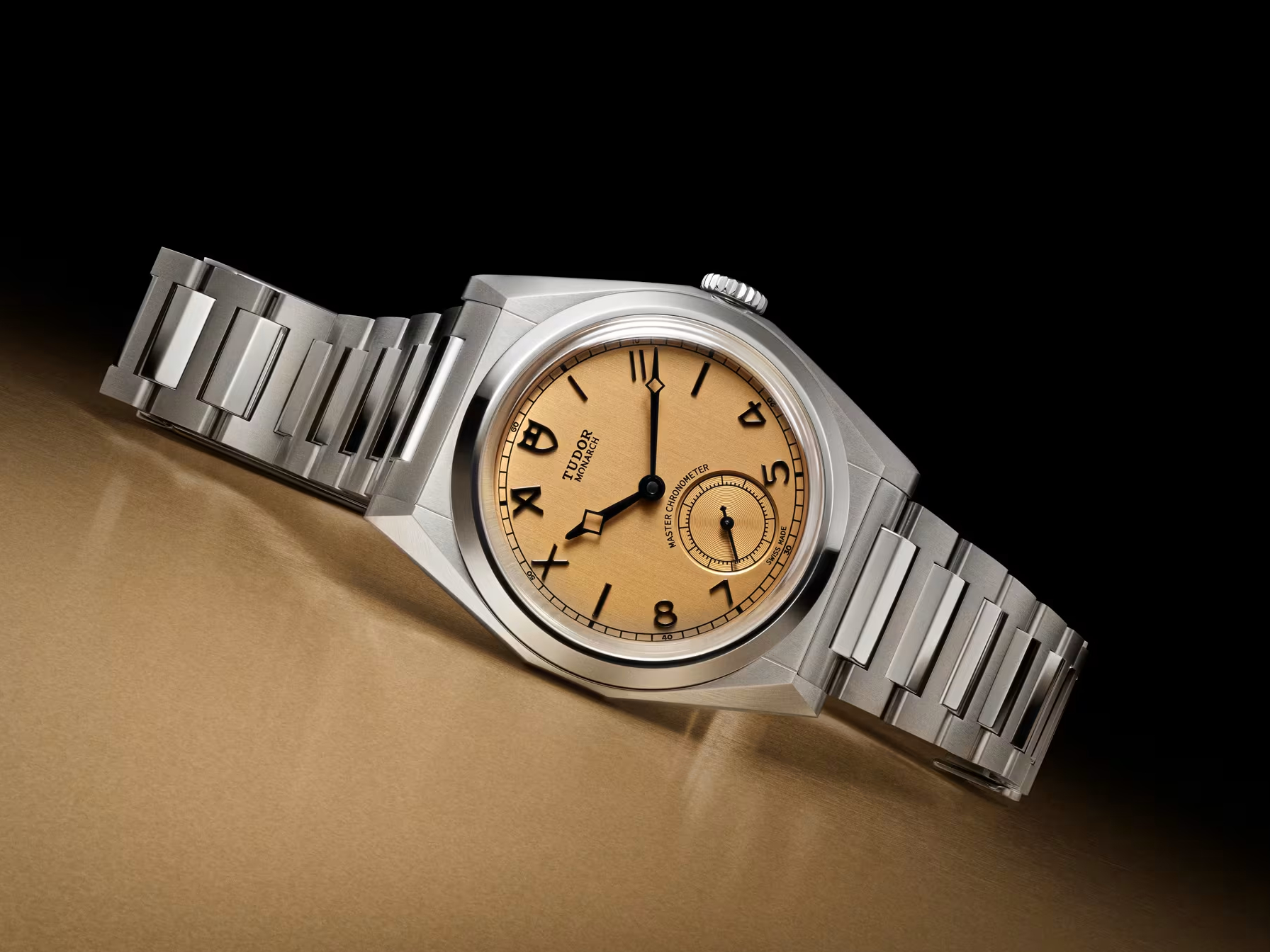
The Monarch and the Dressier Tudor: The 1990s
The original Monarch belongs to a Tudor most enthusiasts have forgotten: the more classical, dress-leaning brand of the 1990s and early 2000s. References such as the two-tone 15733, a piece which evolved the core tenets set out by previous Oysterdate and Date+Day references of prior decades to include variations with details such as applied gold indices and the shield at twelve. This is the watch of 1990s tailoring, of soft-shouldered double-breasted suits, pleated trousers with a generous break, open-collared shirts and the whole relaxed Milanese mood that made two-tone look sophisticated rather than flashy, and with that classic styling firmly back in fashion, a Monarch worn with a loose, drapey suit and a fine-gauge knit is a far more appropriate proposition now than ever.
Today's equivalent: The 2026 Monarch shares its name with the 1990s original but almost nothing else. The California dial is the most telling detail: Roman numerals in the upper half, Arabic in the lower, a format developed for legibility on early military watches. Add a faceted 39mm case and small seconds, and at 11.9mm thick it slides beneath a shirt cuff, making it the right watch to close a story about where Tudor has been and where it seems to be heading.