INTERVIEW
Making Spaces with Piero Lissoni
Celebrated Italian architect and designer Piero Lissoni is widely recognised as a master of contemporary design, and for those who have had the pleasure of sitting down with him, a man who does not mince his words. With his sharp wit and unapologetic point of view, Lissoni shares how each Bucherer boutique becomes a dialogue between past and present, local culture and the Maison’s heritage. From sourcing serpentino stone for the floors in St. Moritz to preserving 19th-century woodwork in the Vienna boutique, no design choice is accidental.
6 Minutes

Portrait by Veronica Gaido
Q: When and how did your collaboration with Bucherer begin?
A: We started working together many years ago, before COVID. It was a competition with some other architects. We won the competition, and it was Mr. Bucherer who chose us and our approach.
The relationship between the firm and the Maison felt collaborative from the beginning. We immediately started working like a team. I think we won because we didn’t set out to design boutiques. Our approach was to create something architectural—spaces that speak the language of architecture and follow its rhythm.
Q: “The language of architecture.” That’s quite poetic. What does that mean?
A: If you take two simple details, like a floor and a ceiling—when I say “the language of architecture,” I’m talking about how these elements debate with one another. For example, many of our boutiques have a few different levels. So, we design a staircase, but it can never be just a staircase. It needs to have an attitude and a point of view—to contribute to this debate.
Q: What excited you most about the collaboration?
A: Bucherer has a global presence, which means boutiques in different cities: Basel, Frankfurt, St. Moritz. Whenever we work in a different town, it’s a different cultural relationship. In our approach, we retain only a few essential details and the rest we adapt town by town, culture by culture.
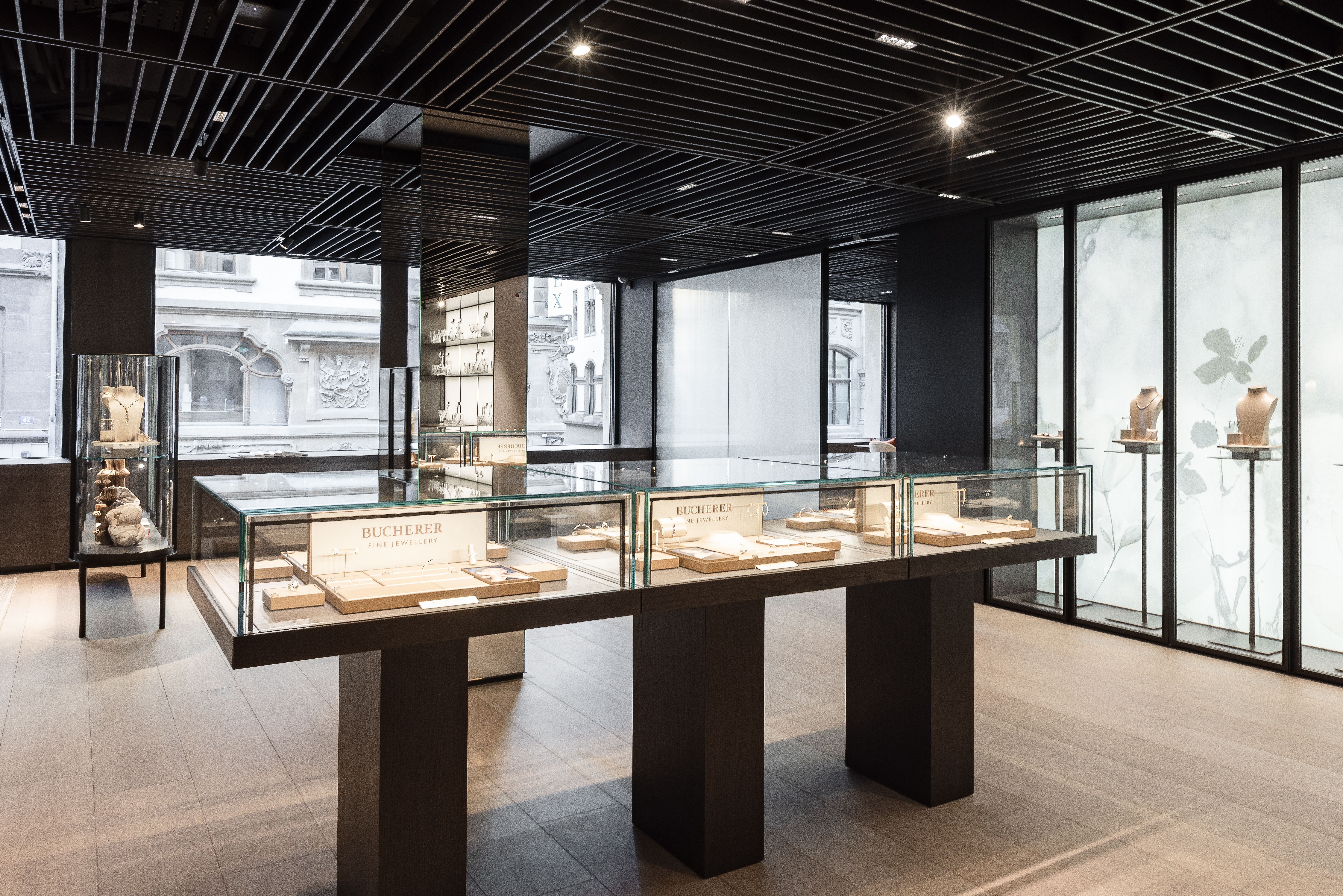
For example, in St. Moritz, we used local stone for the floor. In Frankfurt, we used a special resin and special wood. But for Basel, Frankfurt, and St. Moritz, we designed windows with the same language, the same transparencies.
I need to open the dialogue between old and new."

Q: Speaking of collaboration, you mentioned that the chemistry with the Maison was rather immediate. What does that relationship look like?
A: For example, in Basel, we used a super-prototype, and little by little, with the Maison, we fine-tuned the details. We changed a lot of the furniture; we needed to be a little more gentle. I wanted stronger pieces originally. I don’t know why. I’m Italian.
The conversation was like that. It was never, “I’m the architect. You need to do what I want.” They knew better when it comes to the rhythm and life of these spaces, and they knew the client better. So, I had to learn a lot, but they had to follow me when it came to certain details. That is the level of collaboration.
Q: Where did you find inspiration when embarking on these projects?
A: Normally, it starts with “contamination.” I like to use this word, “contamination,” because we combine many different codes: some of them modern, some contemporary—pieces and materials—some historical, and we mix them together with different cultures. We have pieces from China, pieces from Africa, pieces from India, or America… but at the same time, it was necessary to include something local.
For example, I mentioned the stone we used in St. Moritz. It’s a green stone; it’s called serpentino, which means “little snake.” Inside, we incorporated objects we found locally, like these big pieces of wood that are used to feed deer.
In each boutique, you needed to feel, “Yes, I’m in Bucherer,” but at the same time, “I’m in Bucherer in Basel” or “I’m in Bucherer in St. Moritz,” or somewhere else.
Q: So it’s clear that you worked very intentionally to make sure each store had its own identity, but if you were to use three words to describe a Bucherer boutique, no matter where it is in the world, what would they be?
A: When you go inside a Bucherer boutique, you feel immediately that you are in a special space with another rhythm of life. I think quite elegant, a little bit risky, and at the same time, when you are in a Bucherer boutique, you feel like you are in a unique space. It’s different from the rest of the world—in a good way, not in a bad way. And again, elegance. I do not say this because I designed them, of course.
Q: I think it’s fair to say that’s an objective observation. My next question for you is: how do you provoke emotion in a space?
A: The colours, the materials, the light. We work a lot with different qualities of light. We also focus heavily on the connection, or crossover, between inside and outside, and vice versa. The boutique becomes a sort of magnet. Once you are inside, you’re like a mouse in a trap, no matter what kind of cheese you like.
Q: I see. I’d like to talk a little more about light. I imagine this element of design is incredibly important in spaces that showcase precious stones like diamonds.
A: Yes, and we rely a lot on the Maison and their expertise so that a diamond looks like a diamond, and not something else… I mentioned that we balance the qualities of the light. In the boutique, it’s a little bit amber, which means the temperature is about 1,200–1,400 [Kelvin]. That amber tone makes a difference. When you’re inside, your skin and your face look more beautiful. Some will use light with a temperature of 1,600, which means it’s blue. You become pale and green, depending. The feeling is like being in a laboratory.

Q: How do you feel your own personal design philosophy resonates with the values of the Maison?
A: At the firm, we try to be elegant. We try to be neutral. We try to be strong. I know very well that neutral and strong, technically speaking, are on opposite sides of the spectrum, but we try to combine them. To me, the effect can be very risky, but if you take care and pay attention to some of those risks, the result is absolutely outstanding. So, yes, I think we try to be elegant for some reasons. Strong for other reasons. Risky for other reasons. And why not, new. I think this approach aligns with the values of the Maison.
Q: What do you think distinguishes a Bucherer boutique?
A: I’m going to be honest. When you look inside some so-called luxury jewellery boutiques, it’s ugly. It’s an ugly place for richness. Some of these shops… if you took away the diamonds and the necklaces, and replaced them with shoes or bags, it doesn’t matter. It still kind of works. We have the opposite approach. The image we created is a strong one. It’s a strong and clear language that only works with fine jewellery and Bucherer as a maison. From the beginning, we decided with Bucherer that the goal was to respect this kind of alphabet but to adapt it city by city, project by project, place by place.
For example, we’re starting a new project in Vienna, and it’s in a palace dating from the end of the 19th century. Of course, I am doing my best to respect the regional wooden floors with their somewhat strange motif. In my mind, if I touch that, I am a criminal. I need to open the dialogue between old and new. That’s how we like to do it.