Curated Originals
Omega Seamaster 600 “Ploprof” Reference 166.077: The Ultimate 1970s Professional Dive Watch
In the world of professional dive watches, few models were as purpose-built as the Omega Seamaster 600 “Ploprof” Reference 166.077. Introduced in 1969 during the rise of saturation diving, the Ploprof was engineered to withstand extreme depths and helium exposure. With its monobloc case, locking bezel system, and unmistakable asymmetrical design, the Omega Seamaster 600 remains one of the most technically ambitious and collectible vintage dive watches ever produced.
4 Minutter
In September 1970, three COMEX divers descended into the Gulf of Ajaccio and spent eight days living and working at a depth of 830 feet as part of Operation Janus II, a record-setting experiment in saturation diving. Each man carried the same tool on his wrist: the Omega Seamaster 600 ref. 166.077. Designed for this new frontier of deep-sea work, the watch was tested long before it ever touched salt water. Omega’s engineers had already subjected it to simulated pressures equivalent to more than 3,000 feet.
The Seamaster 600 ref. 166.077, soon known as the Ploprof (taken from Plongeur Professionnel, meaning "professional diver" in French), was not conceived for recreational use. Much like the Rolex Submariner COMEX that followed a few years later, the Omega Seamaster Ploprof was built to survive extreme pressure changes and helium exposure during saturation dives. In the history of Omega’s tool watches, few models were created with such singular purpose. The Seamaster 600 debuted publicly at the 1969 Basel Fair, and a formal press release followed in February 1971, announcing that it would be available at retail later that year.
When Omega began development of the Seamaster 600 in the 1960s, the brand did not adapt an existing design. It built a new type of professional instrument from the ground up. The goal was to create a watch that could function reliably in saturation diving environments, and Omega’s Marine Unit, led by Frédéric Robert, rethought every aspect of construction to achieve it.
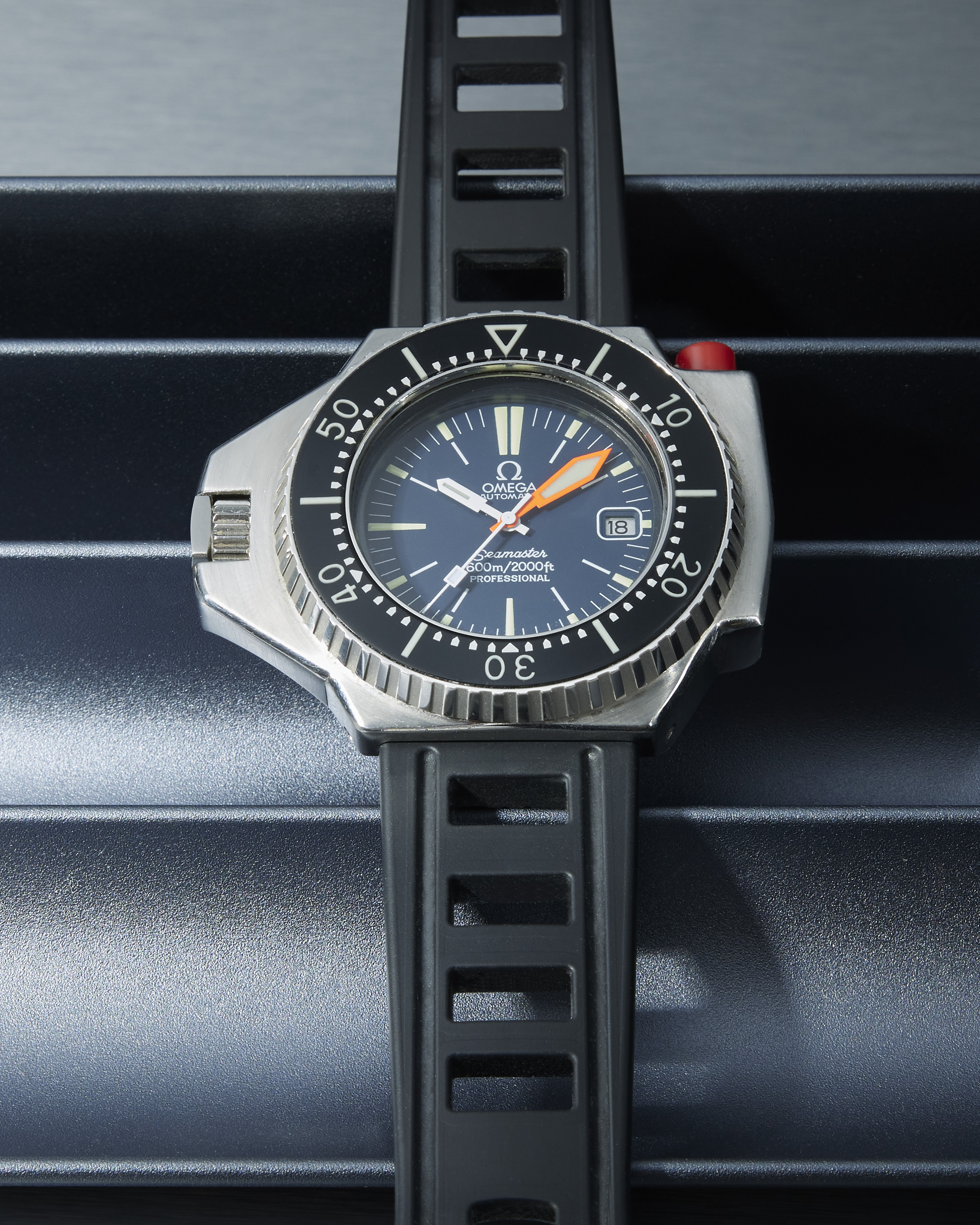
The case became the foundation of the project. Rather than rely on a conventional multi-piece design, Omega used a monobloc case milled from a single piece of steel. This eliminated a major point of failure and allowed the crystal, gaskets, and movement cavity to act as one reinforced structure. As pressure increased, the seals compressed more tightly, improving security at depth. Early experiments explored titanium, but Omega ultimately chose a high-molybdenum stainless steel alloy later known as 904L for its corrosion resistance during prolonged saltwater exposure and underwater welding. As its name suggests, the Seamaster 600 carried an official depth rating of 600 meters, or 2,000 feet.
The Ploprof’s asymmetrical 55mm-wide case was shaped entirely by function. The crown sat on the left side, recessed within a protective housing. Unlike conventional screw-down crowns, the original Ploprof used a square locking nut that tightened the crown against the case. The diver first loosened the nut, then operated the crown to set the time or date, and finally locked it back into place to secure the seal. This system prevented accidental crown movement during work at depth. On the right side of the case, the bright red pusher controlled the bezel-locking mechanism. Unless the diver pressed it, the bezel could not rotate, reducing the risk of miscalculating elapsed dive time.
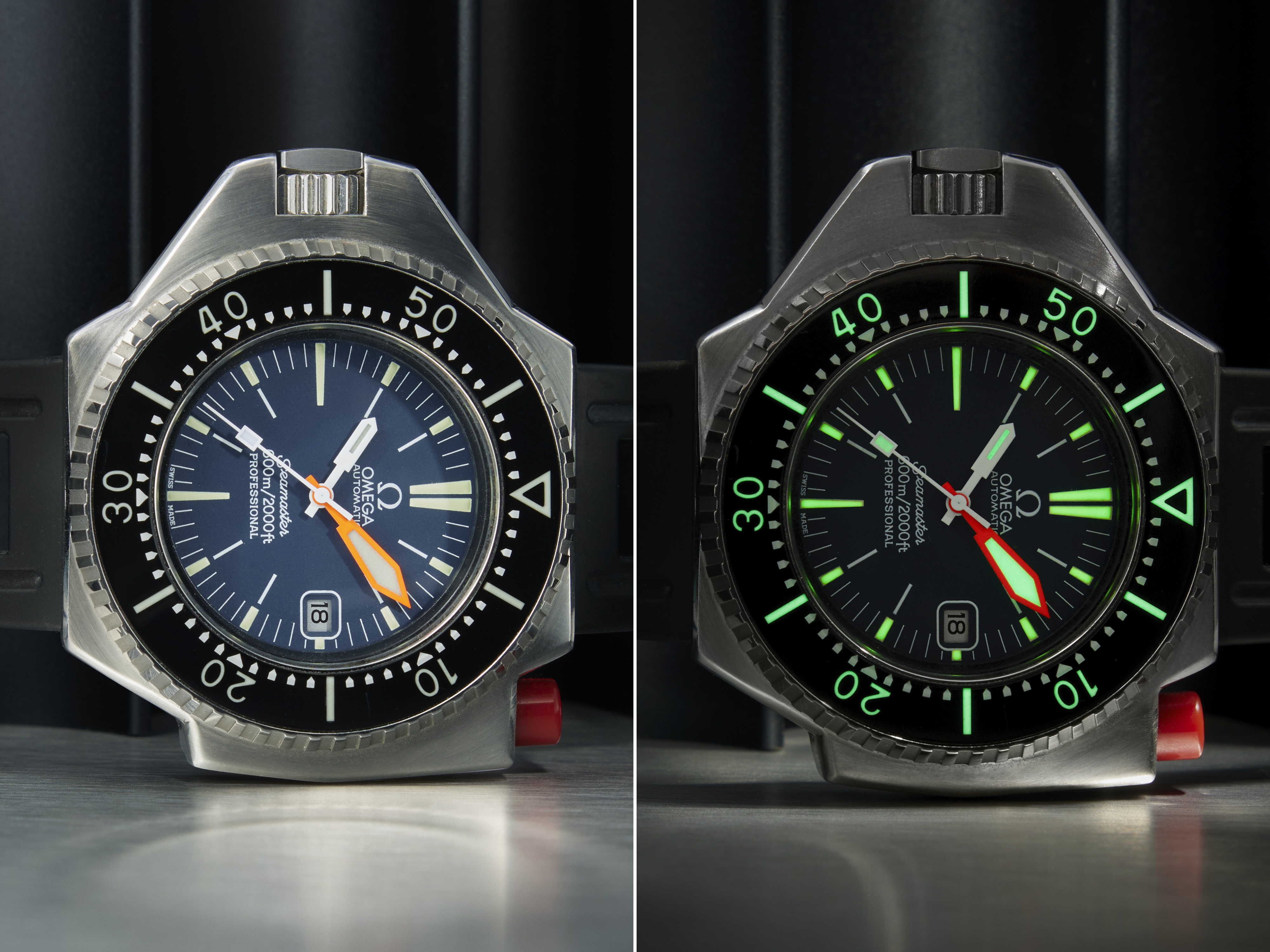
The dial followed the same philosophy. Omega produced it in matte black or deep navy for maximum contrast in low-visibility environments. The large “plongeur” handset, including the oversized orange minute hand, ensured quick reading of elapsed time in conjunction with the lumed bezel. Generous tritium on the hands and markers provided strong visibility during long shifts spent in darkness. A clear minute track surrounded the dial, and a date window at three o’clock offered everyday practicality without affecting legibility.
Omega delivered early examples of the Seamaster 600 on long Isofrane rubber straps, chosen for their flexibility, durability, and resistance to saltwater, and offered in black, blue, red, and a bright safety yellow favored by working divers. A stainless steel bracelet was available as an optional upgrade for buyers who preferred a metal configuration. From 1975 onward, the Ploprof came fitted with the wide shark mesh bracelet that later became closely associated with the model.
The movement was loaded from the dial side and secured beneath a thick crystal built to withstand significant compression. Early prototypes relied on Calibre 1000, while the later production watches, including those sold at retail, used Calibre 1002. The automatic movement beat at 28,800 vibrations per hour and featured an instantaneous date change at midnight, adding modern practicality to the watch’s specialized construction.
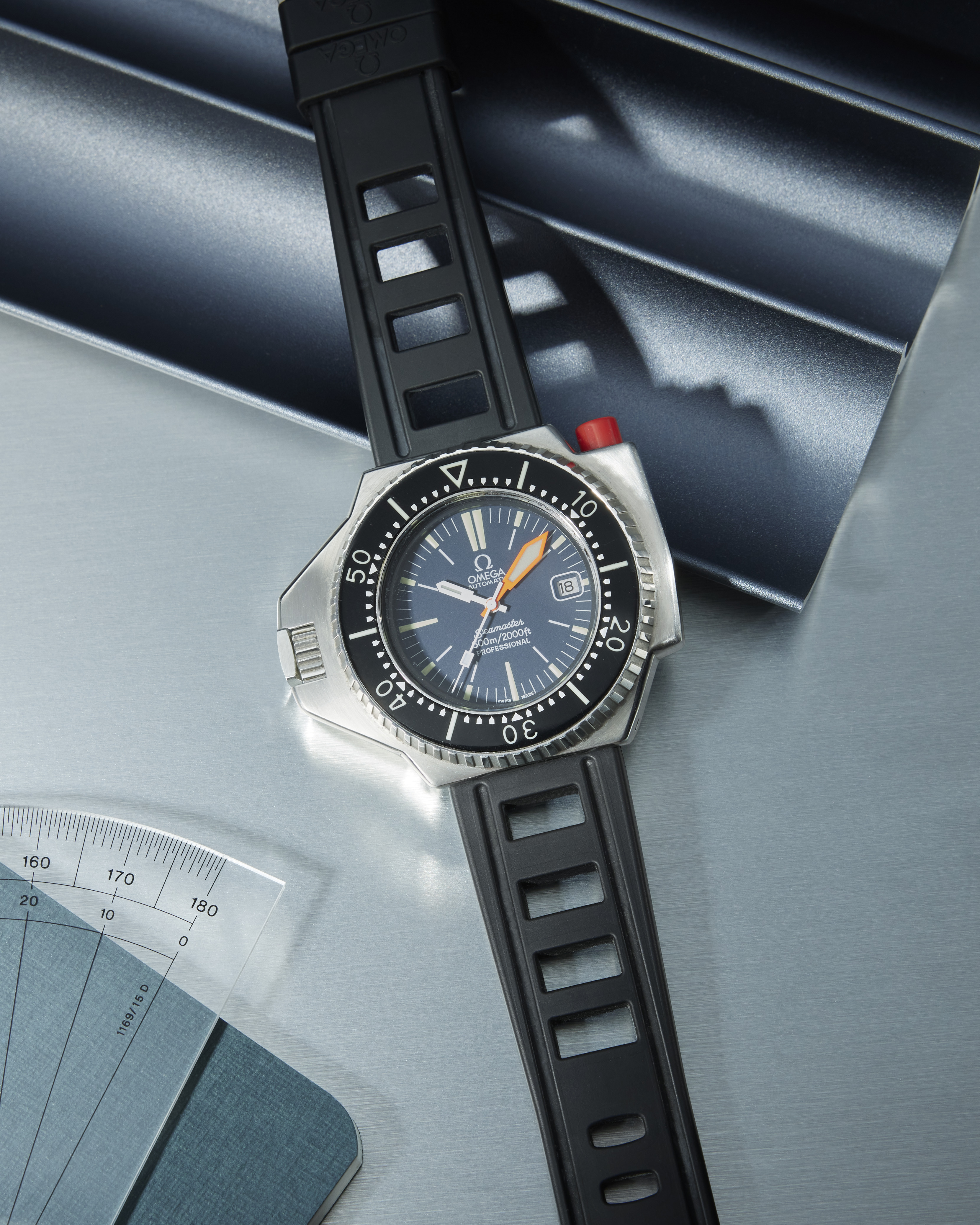
Every element of the Seamaster 600 ref. 166.077 was purpose-built, resulting in one of the most technically ambitious dive watches of its era. Production of the original Seamaster 600 ended in 1979, closing a chapter defined by uncompromising engineering and genuine professional use. Yet the watch’s reputation only grew. Divers, collectors, and historians continued to view the vintage Ploprof as one of Omega’s most mission-driven designs, a tool created for a very specific moment in the evolution of underwater work. Its return in 2009 underscored that legacy. The modern interpretation paid tribute to the original while reminding the wider watch world why the first Ploprof remains such an enduring benchmark.